Somewhere near the summit of a dormant volcano in Oregon’s Cascade Range, along a steep and jagged path of boulders that ATVs struggle to climb, a 1912 Steinway concert grand piano is heaving to and fro in a trailer. What is this 9-foot, 1,000-pound instrument worth tens of thousands of dollars doing at such extreme altitudes? What Wile E. Coyote scheme is afoot?
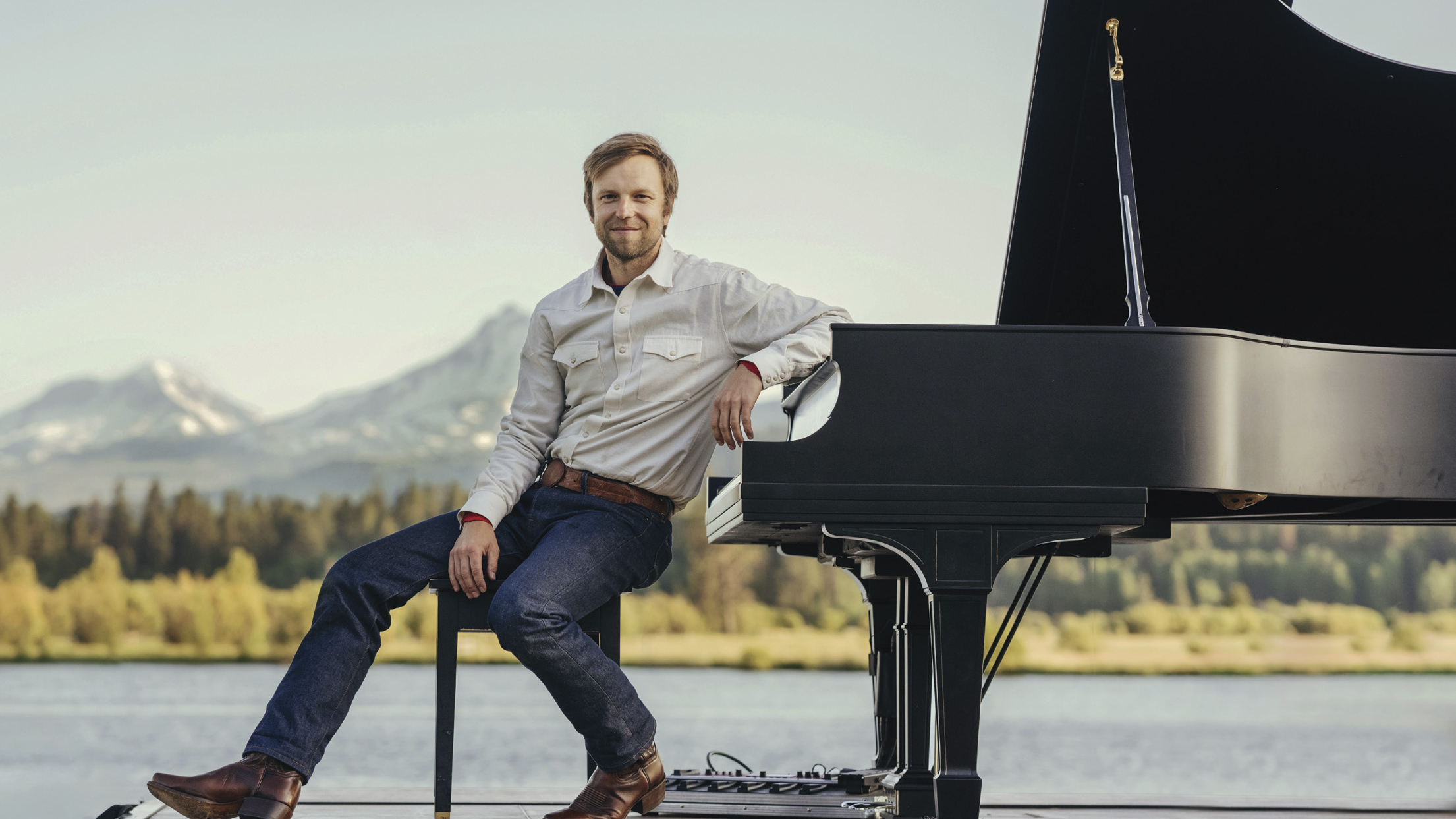
In the truck pulling the trailer, the nimble fingers of a pianist have a death grip on the wheel. His feet are deftly working the pedals—perhaps less gracefully than he works those of the Steinway, but there is a certain art in giving the vehicle enough momentum to mount each rocky obstacle while keeping the precious cargo behind it from hurling down the volcano’s face. Half of the pianist’s mind is on the present trial, but the other half is thinking, This is part of the fun. This is Hunter Noack, and this is hardly the first mountain he and his concert grand have climbed.
In fact, Noack’s done this (or something like it) around 400 times since 2016, the first of 11 seasons of his “IN A LANDSCAPE: Classical Music in the Wild” series. Each year, Noack hits the road with his Steinway Model D—the same instrument found at Carnegie Hall—to discover austere mountains, old-growth forests, barren deserts and unknown reaches of Arcadia across the American West. Each park, summit and shoreline becomes a venue unlike anything live classical music has been played at before.
While Carnegie’s guests remain seated and silent throughout each concert, Noack encourages his listeners to wander the rural landscape while he performs. Participants wear wireless headphones connected to microphones inside his piano, integrating the freedom of the outdoors with the experience of a concert hall. Sometimes he plays Claude Debussy’s “Reflections in the Water” while his audience’s feet are in a creek 200 yards away. Sometimes they’re lying on their backs, gazing at the cosmos in a Dark Sky Sanctuary. Sometimes they’re literally under the piano, pressing their hands to the soundboard to physically feel the sound waves. Every time, Noack is playing a live soundtrack to each participant’s encounter with nature—not so much as a piece to listen to, but a piece to inhabit.
“Some pianists would insist on playing complete sonatas, [whereas] I have no problem playing a movement if it fits in the context of this story and of this place, wherever we’re performing,” Noack says. “It’s less like I’m performing at the audience and more like we’re all listening to this music in this landscape together as it’s all changing all the time.”
John Cage & the Idea That All Sound Is Music
“IN A LANDSCAPE” gets its name from a 1948 composition by experimental composer John Cage, but Noack says the connection between Cage’s piece and his own work is deeper than an applicable title. Cage’s philosophy was that all sound, whether intended or accidental, is music. His most famous (and controversial) piece, “4’33””, instructs the pianist to sit at the keyboard without playing a note for three whole movements. The result is a 273-second score of instrumentless ambience—yet, a complete piece.
“When we’re outside, we don’t even have the illusion of control when it comes to the noises of the landscape,” Noack says. “Sometimes those sounds are birdsong or the sound of waves lapping on the shore. Other times a helicopter will come by, or a train or a siren. And what I encourage everybody to do is to embrace all of those sounds as part of the score, as if it’s all part of the music.”
Many traditional concert halls are engineered to be totally soundproof against the harsh, exterior sounds of the city. Indeed, even rustling a candy wrapper can cause a minor scandal. “IN A LANDSCAPE,” however, welcomes the natural world’s “disturbances” as fellow players in the performance.
Making Classical Music & Nature More Accessible
“IN A LANDSCAPE” is more than a concert in other ways—for instance, it’s also a nonprofit. Noack’s founding mission is to make classical music and nature more accessible—two things that, separately, can feel like they belong to someone else. Some may judge classical music as “lofty,” a thing of urban etiquette, formal dress and high price. Wild places may be limited by distance, gear, permits and a foreboding sense that one must already know how to get there. “IN A LANDSCAPE” aims to reconcile both in a single experience, opening up each one through the other.
Noack says about 25% of every season’s tickets are given away for free through a Good Neighbor Program that grants tickets to community organizations in cities and to ranchers, families and schoolchildren local to the rural areas in which he plays. He says roughly a third of every audience has never attended a live classical music event before.
The Healing Power of Music in Nature
The engendered accessibility of “IN A LANDSCAPE” gets to the core of what Noack wants to accomplish with the series: creating a healing experience. There is no question that music and the outdoors are each restorative forces on their own; Noack couples them to create a tonic that’s truly unparalleled.
A key ingredient is, surprisingly, the headphones. For people with social anxiety, for those who chafe at the formality of concert halls, the headphones create a paradox of privacy and unity.
“I felt closer to the audience in a way,” Noack says. “The feedback from the audience was that, in fact, there’s a real intimacy in having the sound just right in your headphones.”
The healing power of music isn’t metaphorical. Noack himself has experienced it while practicing Franz Liszt’s “Un Sospiro”—Italian for “a sigh”—after a difficult conversation.
“I felt like something in the music was just telling me to let go,” he says. “It was like having healing hands on me. I started to get emotional, and I felt like this kind of release, as if the music [showed me] how to let go and forgive.”
So moving was this moment that Noack selected “Un Sospiro” for his opening number across the 2026 season. Like a commencement ritual at the beginning of a ceremony, audiences took a collective breath of literal fresh air, let go and turned their focus to the wonder of the landscape.
Noack says the music he plays is like an inherited wisdom—“important texts” that generations of performers, curators and composers have deemed worthy of passing on.
“They’re like spells,” he says, “and if I can become good at casting these spells, then I believe that they have some sort of magical power to heal people.”
Supporting a Community After Wildfire Through Music
During the 2025 season, “IN A LANDSCAPE” traveled to the ruins of a mill site just outside Roseburg, Oregon. Five years earlier, deadly wildfires destroyed hundreds of thousands of acres, obliterated homes and displaced an entire community. Noack and his Steinway arrived on the five-year anniversary of that fire. About 80% of the audience were locals—people who had lost property and neighbors.
“To be, in a way, welcomed into the story of the community,” Noack says, “it makes me feel… really lucky. The way that people open up to me and talk about their experience, and how the fire [affected] them, how this 90-minute concert is a part of their healing process, dealing with this trauma of losing everything—it’s incredibly encouraging.”
And there’s the meaning to this whole strange project. A 9-foot concert grand piano wasn’t designed to be played in an Oregon wildfire scar any more than classical music was written to be performed on a Canadian mountaintop. And yet, Noack has redefined the concert hall. He has found the seam between music and nature, and discovered that our innate yearning for both stems from a single impulse: to heal.
The thing is difficult to express in any other way than experiencing “IN A LANDSCAPE” for yourself. But perhaps it was best explained more than a century ago by John Muir, the naturalist philosopher whose writings on Yosemite have inspired Noack as much as any classical composer: “Everybody needs beauty as well as bread, places to play in and pray in, where nature may heal and cheer and give strength to body and soul alike.”
This article was first published in the November/December 2026 issue of SUCCESS® magazine. Get your copy here.
Photo by Jessica Keaveny / IN A LANDSCAPE / Courtesy of Hunter Noack