
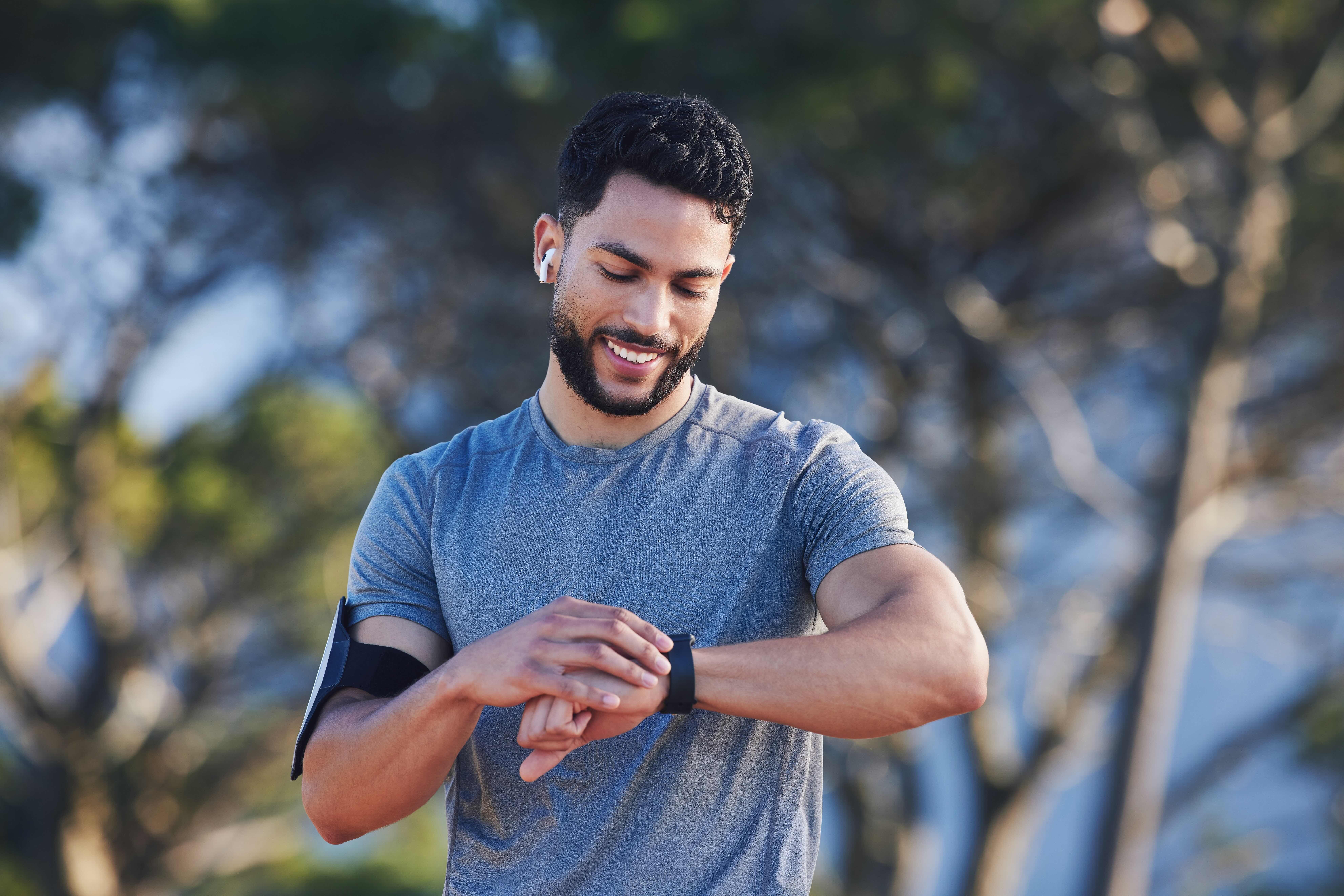
There’s a number on your Apple Watch, Garmin or Whoop that most people scroll past without a second thought. It’s called your cardio fitness score, or more precisely, your VO2 max, and according to a growing body of research, it may be the single most important metric you have for predicting how long you’ll live.
Not your cholesterol. Not your blood pressure. Not your BMI. This one.
Here’s what it means, where you should aim and how to move the number in a meaningful way.
The Number That Predicts More Than You Think
VO2 max measures the maximum rate at which your body can use oxygen during exercise, expressed in milliliters of oxygen per kilogram of body weight per minute. A higher number means your heart, lungs and muscles work together more efficiently under demand. A lower number means those systems are laboring.
In 2022, a research team led by Peter Kokkinos, Ph.D., at the Washington DC Veterans Affairs Medical Center published what is now the largest cardiorespiratory fitness study ever conducted. They analyzed data from 750,302 U.S. veterans ages 30 to 95, across every age group, race and sex. The finding was striking; each one-unit increase in cardiorespiratory fitness was associated with a 13%-15% reduction in all-cause mortality risk, regardless of age, BMI, sex or existing medical conditions. No fitness category was too old or too far gone to benefit from improvement.
The American Heart Association has formally advocated treating VO2 max as a clinical vital sign since 2016, placing it alongside blood pressure and heart rate in clinical assessments. The research is unambiguous enough that some cardiologists now argue low cardiorespiratory fitness is more dangerous than smoking, hypertension or type 2 diabetes as a mortality predictor.
Where You Stand Right Now
Here is the honest benchmark picture, drawn from American College of Sports Medicine normative data by age and sex.
For men in their 40s, a score below 34 ml/kg/min is considered poor; 34-39 is fair; 40-45 is good; anything above 45 is excellent. For women in the same decade, those thresholds shift down by roughly 8-10 points. VO2 max naturally declines about 10% per decade after 30, but the research is clear that most of that decline is driven by deconditioning, not biology alone. A well-trained 55-year-old can have a higher VO2 max than a sedentary 35-year-old.
If your wearable shows a number that looks concerning, use it as a directional signal rather than a precise verdict. Studies consistently show wearables can miss lab-tested values by 5%-15% in either direction. What they’re excellent at is showing trends. If your number climbs from 38 to 43 over six months, that improvement is real and it matters for your health, regardless of the absolute accuracy of the baseline.
The Most Important Threshold to Cross
One finding from the Kokkinos study deserves particular attention: The mortality benefit is not linear. The biggest gain doesn’t come from going from good to excellent. It comes from moving out of the lowest fitness tier into the average range.
Going from the bottom 20th percentile to average fitness is associated with a reduction in mortality risk larger than the benefit of quitting smoking. You don’t need to become an athlete to gain meaningful protection. You need to stop being sedentary.
Dr. Peter Attia, a physician and longevity researcher, has emphasized this point repeatedly in his clinical work: The goal is not optimization for its own sake, but crossing the threshold where your aerobic fitness no longer constitutes a significant mortality risk. For most people reading this, that threshold is within reach in 8 to 12 weeks of consistent structured training.
Two Training Tools That Move the Number
Research points clearly to a two-mode approach for improving VO2 max efficiently. Neither requires a gym membership or expensive equipment.
Zone 2 cardio is exercise at roughly 60%-70% of your maximum heart rate, an intensity where you can hold a conversation but feel some effort. The simplest test: If you can speak in full sentences without gasping, you’re probably in Zone 2. Iñigo San-Millán, Ph.D., an exercise physiologist at the University of Colorado School of Medicine who coaches Tour de France cyclists, has built a training framework around the principle that Zone 2 is the intensity that most effectively stimulates mitochondrial biogenesis, the creation of new mitochondria in muscle cells. More mitochondria means better aerobic capacity, better metabolic health and better energy production at every level of effort. San-Millán recommends sessions of 45 minutes to two hours, at least three to four times per week, for meaningful mitochondrial adaptation.
High-intensity intervals (sometimes called Zone 5) are the second tool. Research from the Scandinavian Journal of Medicine & Science in Sports and multiple meta-analyses confirms that aerobic high-intensity intervals produce greater VO2 max improvements than continuous moderate training alone. Attia’s preferred protocol for his patients: four minutes of hard effort at the highest sustainable intensity, followed by four minutes of easy recovery, repeated four times. Done once or twice per week alongside Zone 2 work, this combination targets both aerobic base and peak capacity.
The most common mistake is doing all your cardio in the middle—too hard to build a true aerobic base, not hard enough to drive peak adaptations. Most people’s “easy” runs are actually Zone 3 or Zone 4. If you finish every workout feeling moderately tired, you may be working in the range that builds neither quality well.
The Practical Starting Point
You don’t need a lab test to begin. Your wearable gives you a working baseline; field tests like the Cooper 12-minute run give you a slightly more accurate one. What matters is establishing a number you can track over time.
The protocol from here is straightforward: three to four Zone 2 sessions per week of 45 minutes or more, plus one session of high-intensity intervals. Walking briskly counts as Zone 2 for deconditioned individuals. Cycling, rowing and swimming all work. The activity matters less than the intensity and consistency.
Check your wearable’s VO2 max estimate every four to six weeks. Expect modest improvements in the first month as your body adapts neurally, then more substantial gains in months two through four as mitochondrial density builds. Research shows untrained individuals typically see 15%-20% improvements within 20 weeks of structured work.
Your body is the engine. VO2 max is the readout that tells you how the engine is actually performing—not how it looks, not how it feels on a good morning, but how much capacity you’ve built for the long road ahead. That number is changeable. You can start changing it this week.
Featured image from PeopleImages/Shutterstock