

You have survived hard things before.
That is exactly why the next crack can feel so confusing.
You are still showing up. You are still performing. And then a small inconvenience—a delayed delivery, a blunt email, a driver who cuts you off—hits like a category-five event. You wonder what is wrong with you.
Often, nothing is.
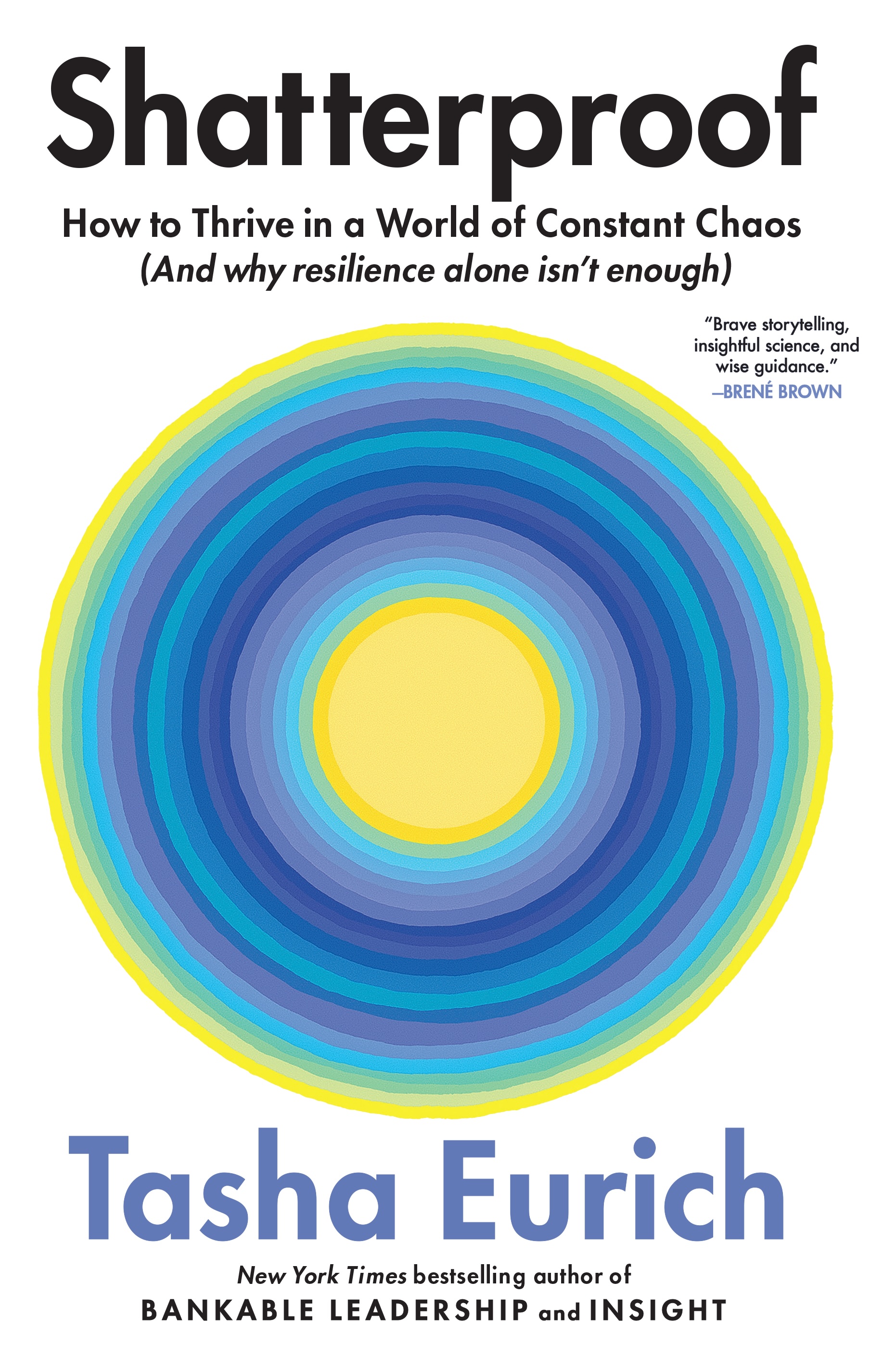
According to organizational psychologist Tasha Eurich, Ph.D.—bestselling author of Shatterproof: How to Thrive in a World of Constant Chaos and an executive adviser to leaders at organizations including Google, Walmart and the NBA—you may be approaching your resilience ceiling: the upper limit of what your coping system can hold before it fails on impact.
“If you feel yourself running out of resilience,” Eurich told SUCCESS®, “it’s not you failing to be resilient. It is a limit of resilience itself.”
That reframe matters. Stressed-out strivers—the high-achievers who shoulder work, family, aging parents and constant uncertainty—can stay “fine” until the second they are not.
Eurich’s research program on how people navigate adversity found that resilience alone did not predict who grew stronger through crisis. Many people bounced back. A smaller group grew forward. The difference was not more grit. It was a second skill set: paying attention to pain, naming unmet needs and pivoting before the tank ran dry.

Dr. Eurich sharing her insights with the audience at the Unplugged Leadership Conference
“I think we use resilience as our whole toolbox,” Eurich said, “instead of one specific coping tool that has limits.”
Economists who track the World Uncertainty Index across 143 countries report a hockey-stick spike in global uncertainty over the past two years. For you, that can mean a higher baseline of stress punctuated by crises you did not schedule. “We can be as resilient as the day is long,” Eurich said, “until the second that we’re not.”
Here is how to see that moment coming and what to do while you still have choices.
Sign 1: You’ve Lost the Mojo
The first warning is internal, but people around you can often sense it.
You wake up. You execute. You hit your numbers or your deadlines. Technically, you are fine.
Emotionally, you have lost the love of the process.
Eurich calls this lost mojo. You’re going through the motions without the spark that used to pull you forward. Her friend and mentor Marshall Goldsmith describes it as losing “the love of the process,” the felt sense that the work still matters to you, not just the outcome.
One CEO Eurich coached was leading a massive company transformation. Every week, when she asked how he was doing, he said the same thing: “I’m fine.” The tight-jawed kind of fine everyone pretends to believe.
Then one day, after a routine meeting, he called her. He had snapped at his team over moderately bad news that on any other day would not have rattled him.
That is the ceiling arriving in public: not a meltdown over a catastrophe, but a snap over something that would not have touched you six months ago.
SUCCESS Tip: Ask yourself honestly: Compared to my usual self, am I still connected to why this work matters, or am I just performing resilience?
Sign 2: Little Things Feel Huge
The second sign is what Eurich calls little things feel big.
The route to your coffee shop is the same. The colleague’s tone is familiar. The scope of the problem is manageable. Your reaction is not.
You feel rage, tears or shutdown disproportionate to the trigger. Others may see it before you do. The CEO’s outburst is the classic version. Your version might be food that never arrives, a gate that will not open or a “can you go back one slide?” question in a presentation that suddenly feels like an attack on your competence.
Eurich has not yet published data on whether most “feather” moments map to one need over another. Her educated guess, grounded in decades of motivation science: Many last-straw events are confidence, choice or connection feathers—small triggers that land on needs already running empty. “If my needs have been constantly frustrated and my spouse snaps at me, maybe that’s the feather,” she said. “But the reason that is the feather is because it’s pulling at the connection when my other needs are already strained.”
Confidence is not just effectiveness. “It’s the feeling that we’re not just effective,” Eurich said, “but we’re growing.”
Choice is agency and authenticity. “It’s not just having control over our lives,” she said. “It’s being able to sort of be who we authentically are.”
Connection is belonging and mutual support, not networking volume, but whether you feel held.
When any of those needs is thirsty, a minor stressor can feel existential.
SUCCESS Tip: When you overreact, do not lead with self-blame. Lead with curiosity: Which of the three needs is this touching, and was it already low before today?
Sign 3: Your Gold-Standard Coping Stops Working
The third sign is the one high-achievers resist most.
The practices that used to restore you—morning routine, gratitude, the walk, the quiet hour on the patio—stop working. Worse, they can leave you more activated because you finally have stillness to feel everything you have been outrunning.
For Eurich, the clue is quiet time outside that used to calm her nervous system. “When I go out on my patio, and my nervous system is even more on fire,” she said, “because now I have the time and space to think about all these things that are stressing me out—that’s a clue.”
That is different from burnout, though the two can overlap. Burnout tends to build slowly and center on work exhaustion. The resilience ceiling can hit suddenly, across every domain of life, even when your job title still looks fine on paper. You are fine. Then you are not.
And the failure, Eurich is careful to emphasize, is not yours. “It’s not a flaw of us,” she said. “It’s a flaw of what we’ve been taught are the kind of gold-standard coping strategies.”
Eurich uses a simple rule: If two of these three signs are present, you are likely nearing or at your ceiling.
What Grit Gaslighting Sounds Like (and Why It Makes Everything Worse)
Before you can reset, you have to stop arguing with yourself.
Eurich coined the term grit gaslighting for what happens when you—or the people around you—treat normal limits as a character flaw. Internally, it sounds like:
“Other people have it harder. What am I whining about?”
“Why can’t I just suck it up?”
“I’ve been through worse. Why is this getting to me now?”
You compare your worst hour to everyone else’s highlight reel.
“It makes us feel like we’re not doing enough,” Eurich said, “and then that inevitably leads to it mak[ing] us feel like we are not enough.”
Social media accelerates that math. So does toxic positivity—the “stay positive” script that pressures you to perform OK-ness when you are not OK.
Eurich’s first step in her Shatterproof road map is probe your pain: not to wallow, but to treat discomfort as data. “Even if this wouldn’t be an issue for anyone else,” she said, “this is an issue for me, and that’s real. And it doesn’t make me weak. It actually makes me strong because I’m paying attention to it.”
SUCCESS Tip: Replace “What’s wrong with me?” with “What is this stress trying to tell me?”
What to Do in the First 24 Hours: The 2-2-2 Reset
When Eurich asks what one move matters most on the first day after you recognize the ceiling, her answer is immediate: the 2-2-2 method.
Give yourself exactly 48 hours before you try to solve the whole problem. In that window, triage three time horizons:
Two minutes: Immediate relief. Lie down. Breathe. Let your body register safety.
Two hours: Short-term first aid. Cancel what you can. Eurich’s version: “I’m going to remove that stress that’s telling me that I am a worthless person unless I produce.”
Two days: Deliberate rest—not catch-up chores disguised as recovery.
Eurich used 2-2-2 the day after she overdid it on a New York work trip while managing a chronic illness. Two minutes in bed. Two hours of choosing not to force a workday. Two days of refusing to “spring clean” her way through exhaustion.
“You’re not pulling back because you’re lazy,” she said. "You’re pulling back because you want to move forward.”
That last line is the whole philosophy. Stressed-out strivers are programmed to push harder at the wall. When Eurich studied the people who actually grew stronger through adversity, she kept hearing the same answer. “I’d ask, ‘And then what did you do?'” she said. “And they said, ‘I pulled back. I took a break. I gave myself some grace and some space.'”
It is the opposite of what successful people are programmed to do. That, she says, is exactly why a simple tool helps.
3 Questions That Beat Another Resilience Spreadsheet
Eurich once tracked her own resilience practices on a daily spreadsheet—gratitude, walks, meditation, specialist appointments, checkmarks for every “good” behavior. As her health crisis deepened, the sheet stopped helping. She stopped filling it in. She stopped printing it.
The lesson: When the paradigm is broken, more of the same paradigm will not fix it. “If I’m pushing and pushing and pushing, and I metaphorically keep hitting a brick wall every time,” Eurich said, “instead of trying one more time to get through the wall, I need to metaphorically turn around and look for a different path.”
Instead, she offers three questions you can run in five minutes:
Compared to my usual self, am I feeling more ___ than usual? (anxious, frustrated, disconnected, numb)
What do I need that I’m not getting right now? (confidence, choice or connection)
What is one small thing I can do in the next 24 hours to feed that need?
“We can’t always remove the stressor,” Eurich said, “but we can start doing different things to feed the need.” A rough day with a territorial co-worker might mean a real conversation with a friend that night—not to vent forever, but to refill connection so work does not own your entire emotional budget.
Psychologists call these small shifts need crafting. Research suggests that meeting a need in one area of life can raise satisfaction in others—confidence built on a new hobby can show up in how you lead a meeting. “It’s one of the best-supported theories in psychology,” Eurich said, “that nobody has ever heard of.”
SUCCESS Tip: Pick one need. Plan one 24-hour action. Repeat tomorrow.
When the Culture Is Mining Resilience Instead of Building It
The ceiling is not only personal.
Eurich watches organizations praise resilience while ignoring the structures that deplete it. A red flag she sees again and again: senior leaders complaining that people “aren’t working hard enough” or “everyone’s whining” while demanding more with less.
She points to a footnote from Shatterproof she still thinks about—an interview with a nurse whose hospital responded to a real staffing shortage by rolling out resilience training. The nurse’s response, as Eurich recalls it: “Hey, instead of blaming us for not being resilient enough, why don’t you fix the structural issues that are going wrong in your company?”
The message of resilience-as-fix lands as blame: If you were tough enough, the system wouldn’t hurt.
“If there isn’t ownership on the part of the leaders for the culture and the experience that the employees are having,” Eurich said, “that’s a red flag."
If you are the leader, fix the load before you fix the mindset. If you are the employee, name the gap between what you are asked to endure and what you are given to endure it with, and protect your ceiling like the finite resource it is.
What a Health Crisis Teaches About Limits (and Second Chances)
While writing Shatterproof, Eurich was diagnosed with Ehlers-Danlos syndrome, a connective tissue disorder that reshaped how she could work, travel and recover. Before COVID, she flew roughly 250,000 miles a year. When the adrenaline of constant motion faded, her symptoms surged.
She hit her ceiling in a familiar way. After a specialist attributed crushing pain to turning 40 and sent her home with nothing resolved, she went home, changed into pajamas, got into bed and thought, I can’t do this anymore.
“That was the moment that I hit my resilience ceiling,” she said. “And from there, the coping did not get better. It got worse because I just stopped coping. I just gave up.”
The research she was running in parallel stopped feeling academic. It felt lifesaving.
“I had never felt as incompetent and unchoiceful and disconnected [from people, from myself] as I did in that moment,” she said. “That was why it was such a revelation when our team finally put this together: if you can’t change the stressor, you can change how you feed the need.”
Rebuilding confidence, choice and connection—including how she advocated in medicine—became the path back. “It’s not an exaggeration to say that research program,” she said, “I’m pretty sure saved my life.”
That story is not a template for every reader. If you are in an acute mental health crisis—if you want to harm yourself or cannot get out of bed—Eurich is clear: This article is not the intervention. A licensed clinician is. This piece is for strivers who are fraying under load, not for emergencies that require professional care.
Your 7-Day Check-In
You do not need a perfect life to move forward. You need an honest read and a small next step.
Take Eurich’s free Resilience Ceiling Quiz (five minutes, with an option to invite someone who knows you well to weigh in). It scores five dimensions of your coping resources and suggests customized actions, not a generic “be more resilient” lecture.
Then watch for two of the three: lost mojo, little things feeling big, gold-standard tools failing. Catch them early, and you are not weak. You are paying attention.
That is how you stay shatterproof in a world that keeps asking you to bounce back when what you actually need is to grow forward—on purpose, with limits that finally make sense.
Images provided by Dr. Eurich and voronaman/Shutterstock