
Here’s a fact that should stop every high-performer in their tracks: Some people hit their 80s and outscore 50-year-olds on memory tests. Not slightly—by a margin that has baffled neuroscientists for 25 years.
Northwestern Medicine researchers call them “SuperAgers,” and they’ve been studying this group since the late 1990s. This past February, they published their most significant discovery yet in the journal Nature: SuperAgers make at least two to two and a half times more new neurons than their typically aging peers and Alzheimer’s patients, respectively. That’s not a marginal biological edge. It’s a fundamentally different brain trajectory.
But here’s the part that matters for you: The behaviors these people share aren’t exotic. You can start most of them today.
What Scientists Actually Found in SuperAger Brains
Before getting to the habits, it helps to understand why this discovery is so significant. For decades, scientists debated whether the adult human brain could generate new neurons at all. This study settles that question and then some.
Immature neurons were roughly two and a half times more abundant in SuperAger brains than in other aged cohorts, and the pattern held even after the team excluded one donor who was a clear outlier. Those new neurons don’t just sit there. They’re the brain’s most adaptable cells, capable of integrating into existing circuits, strengthening memory formation and helping the brain repair itself in the face of aging.
The findings also revealed something equally striking. SuperAgers have two distinct strategies for staying sharp. One is resistance: Their brains simply don’t make the plaques and tangles associated with Alzheimer’s disease. The other is resilience: They make them, but those proteins don’t impair cognitive function. Either way, the brain finds a way through.
The Habit That Appears in Almost Every SuperAger
Across 25 years and hundreds of research participants, one behavioral trait keeps showing up with more consistency than any other: deep, active social engagement.
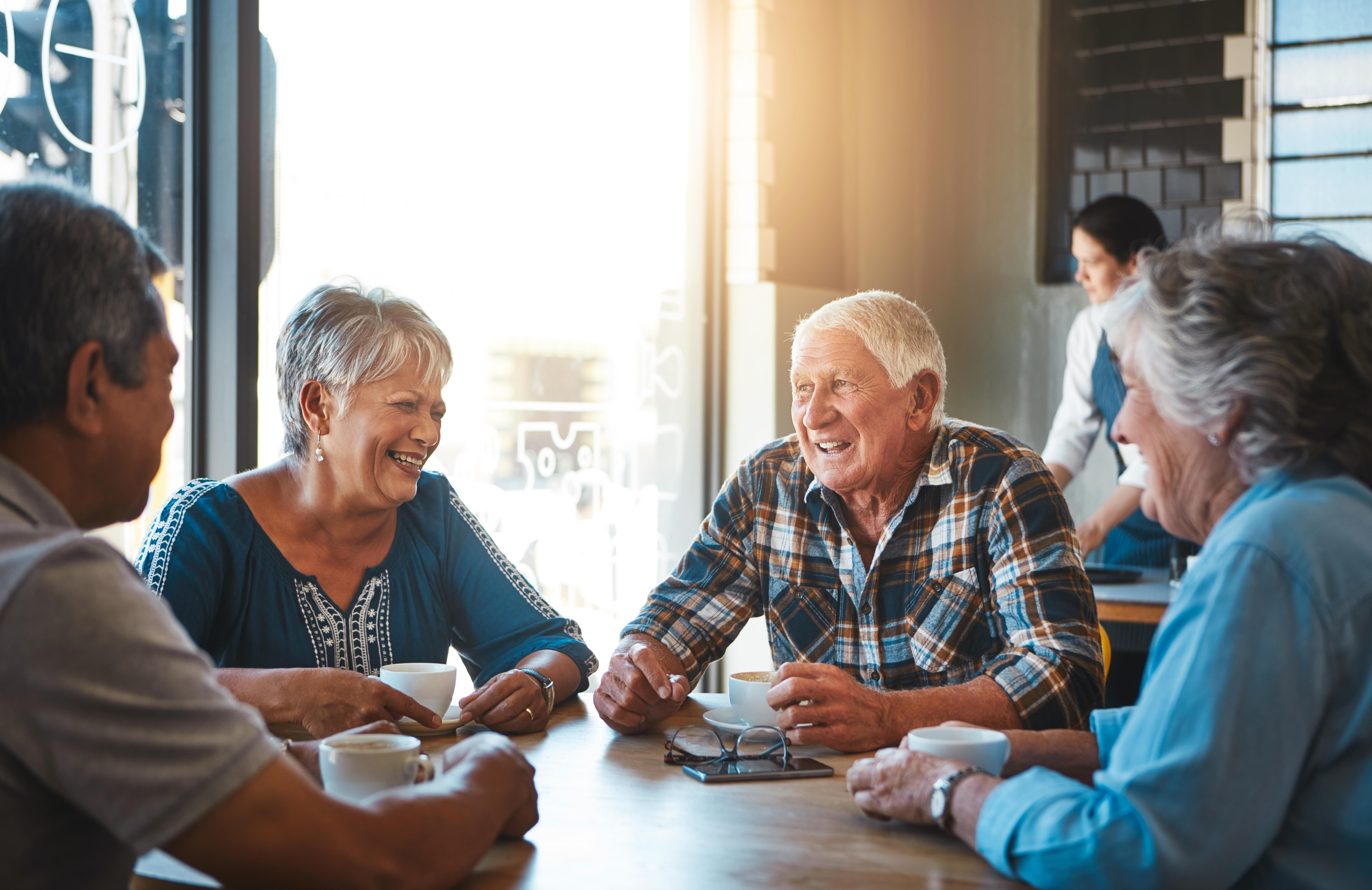
Despite having diverse lifestyles and varying approaches to exercise, SuperAgers tend to be highly social and report strong interpersonal relationships. This isn’t passive socializing; it’s regular, meaningful connection. The Northwestern SuperAging Program has found that these individuals don’t just have acquaintances; they maintain relationships that require effort, reciprocity and ongoing investment.
The biological reason matters here. SuperAgers consistently show a higher number of von economo neurons—specialized cells linked to social behavior, intelligence and awareness. These neurons are also found in animals known for strong memories, like elephants. Social engagement doesn’t just feel good; it appears to exercise the very circuitry that keeps memory intact.
The action: Audit your social calendar, not your work calendar. How many of your conversations last week required real attention and genuine reciprocity? That number matters more for your brain health than you’ve likely been told.
They Keep Asking Their Brains Difficult Questions
SuperAgers tend to be positive and challenge their brains every day by reading or learning something new. Many are physically active and continue to work into their 80s. The common thread isn’t any single activity. It’s the consistent demand placed on the brain to engage with something hard.
Dr. Andrew Budson of Harvard Medical School has described this as the cognitive equivalent of physical exercise: use it or lose it. The brain regions that SuperAgers preserve—the hippocampus, the anterior cingulate cortex, the entorhinal cortex—are precisely the regions activated by complex thinking, novel learning and tasks that require sustained attention.
Passive consumption doesn’t qualify. The challenge has to be real.
The action: Pick one domain where you’re a beginner and commit to deliberate engagement for 20 minutes a day. A second language, an instrument, a complex book outside your field. The cognitive strain is the point.
Physical Activity Is in the Profile, But Not Equally
Research on SuperAger lifestyle factors has consistently found higher engagement in vigorous physical activity compared to cognitively average older adults. Not necessarily marathon training, but movement that genuinely elevates heart rate and challenges the body.
Why does this connect to brain health? Dr. Richard Isaacson, director of research at the Institute for Neurodegenerative Diseases of Florida, explains it directly: lifestyle changes, including diet, exercise, reducing stress and optimizing sleep, along with managing vascular risk factors, can grow brain areas, including the hippocampus and reduce telltale signs of Alzheimer’s such as tau tangles and amyloid plaques. Physical activity isn’t just good for your body. It’s one of the most reliable levers for growing the brain region most critical to memory.
The action: Three sessions per week of effort that requires genuine exertion—anything that makes conversation difficult—is a defensible minimum. The specific activity matters less than the consistency.
Sleep Is Not Optional
SuperAgers treat sleep as a nonnegotiable cognitive investment rather than a flexible variable. Adequate, restful sleep is a critical but often overlooked factor in brain health. Aiming for 7 to 9 hours nightly helps the brain clear waste products, including those associated with Alzheimer’s disease. Sleep is also when the brain consolidates short-term memory into long-term storage, which means chronic sleep restriction isn’t just an energy problem. It’s a memory problem.
For high-performers, this is often the first habit sacrificed. The SuperAger data suggests it may be the most expensive trade you’re making.
The action: Track your actual sleep hours for two weeks. Not what you intend to get—what you actually get. If the average is below seven hours, you’ve found your most urgent brain health intervention.
A Word of Honest Caution—and Why It Doesn’t Change the Picture
Northwestern’s Dr. Tamar Gefen has been careful to note that the science isn’t yet at the point of prescribing a behavioral recipe guaranteed to produce SuperAger neurogenesis. Genetics almost certainly plays a role. Some people have biological advantages that no lifestyle choice fully replicates.
But that caveat doesn’t diminish the case for acting on what the research does show. The habits consistently found in SuperAgers—rich social engagement, continuous cognitive challenge, regular vigorous movement and protected sleep—are the same behaviors linked to brain health across the broader aging literature. You’re not chasing a guaranteed outcome. You’re stacking the odds.
The question worth sitting with isn’t whether you’ll be a SuperAger at 80. It’s whether the habits you’re building today are ones that give your brain the best chance.
Featured image from PeopleImages/Shutterstock