
In 2019, when he was working full-time at a high-paying finance job, Aditya Madiraju became famous overnight. He and his husband were among the first gay couples to get married publicly in a Hindu temple, and photos of their New Jersey celebration went instantly viral.
Soon, Madiraju was in his company’s human resources office getting clearance for all the article being written about him. And with tens of thousands of new followers, something else started to grow: the makings of a platform.
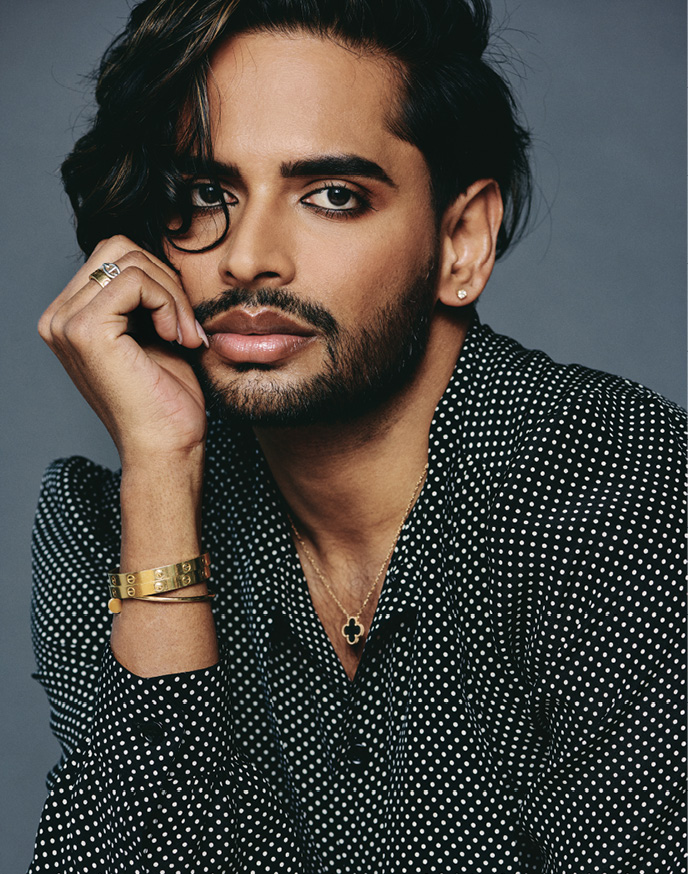
Aditya Madiraju courtesy of ©Fernando Rodriguez
How Aditya Madiraju Went From Finance to Full-Time Creator
Two years ago, Madiraju was working in finance by day and recording makeup tutorial videos by night, growing the audience he accrued from coverage of his wedding. Eventually, after often working into the wee hours, he reached a point of exhaustion. He and his husband decided he should give the full-time creator life a fair shot, and he put in his notice.
“I think somewhere deep down, I just knew: The moment I make makeup my whole existence, it will literally become my whole existence,” he says.
And it has. For Madiraju, cosmetics aren’t just an industry; they’re instruments to practice an art form, one that is tremendously personal to each individual.
“With each layer that goes on your face, your personality transforms into your version of what you have in your mind,” he says. “There’s a beauty in it, because a lot of people find strength in makeup. Some people find escape in makeup. For me, I think I found my life’s purpose in makeup.”
Now, millions of followers and major beauty brands have led Madiraju to collaborate with household names like L’Oréal and appear at Paris and New York fashion weeks—and there’s more coming.
Why Influencers Need a Lawyer and a Manager
If you have a dream of leaving your career to become a creator—or building and leveraging a strong following to benefit your small business—Madiraju recommends taking it seriously right from the start.
“Get a lawyer; get a manager,” he says. “This is an investment. Yes, you’ll be giving away a part of your revenue, but this is an investment that you need to protect yourself, because everyone you work with is protecting themselves. That’s just the real world.”
He also recommends being consistent, regardless of how individual videos might explode or fizzle with little interaction. Don’t let the successes get to your head, he says, and don’t let the disappointments discourage you, either.
“I could cry that I don’t get views sometimes, but that’s just part of the game; that’s just part of the career,” Madiraju says. “You’ll think this is the most groundbreaking work you’ve ever done, and it’ll flop and fail amazingly, and that’s just it—you have to be OK with it. And when something goes viral and you’re having success in your life, don’t let it go to your head. Because that will end as well.”
How the Algorithm Pigeonholes Content Creators
Here’s the part that doesn’t often get talked about, Madiraju says: Creators are often siloed into churning out content for one category, or repeating a single quirk that keeps raking in the views, even if that’s not what they necessarily want to be known for.
For Madiraju, it’s his style of comedic yelling that his followers seem to have latched onto.
“I’m trying really hard for my content not to be yelling,” he says, “but it really helps when I yell in the first three seconds. That’s what the algorithm wants. And the algorithm is pretty much dictating what every creator can do.”
But there’s a lot more to Madiraju than those catchy phrases he shouts. His real passion lies in teaching the techniques he shares in his videos—the art behind the noise. He loves creating functional tutorials to teach people how to freshen up their look or get more creative with the art of makeup.
With more than 3 million followers on Instagram and 2 million on TikTok, Madiraju is now scheming about the next step to take his creator career beyond the algorithm, potentially to create his own products or start his own makeup business. Cosmetics don’t come cheap, and he wants to build products that people can use in a wide variety of ways for maximum versatility.
Why “Authenticity” Is Overrated on Social Media
If you think your job is demanding now, just wait until you see what it’s like to be an influencer. You might not be staring at spreadsheets all day, but it’s far from a full-time vacation. Madiraju might film for hours to produce a few one-minute videos, he’s often editing at 3 a.m., and he occasionally gets recognized in grocery stores and airports.
To be clear, he’s not complaining—he wakes up and looks forward to going to work every day, he says, which is not how he felt about his previous 9-to-5 (ish) finance gig. Even still, “there is no rule book,” he says. “It’s literally who you are.”
That’s his best advice for making it: Forget “authenticity”—a meaningless buzzword he would like to ban forever—and just “keep it real.”
“The first time you post something, that is real and authentic,” he says. “The second time you post it, you tailor it so the audience consumes it in a better way. The third, fourth, fifth time you post it, you’re trying to get a newer audience to come to you. So only the first time when you do it, it’s authentic. After that, it’s a tailored version of you.”
The View From ‘Cringe Mountain’
The process of turning oneself into an influencer is often referred to as climbing “Cringe Mountain.” That’s what happens when your friends and family see you performing online for an audience that doesn’t yet exist. To “make it,” you have to get to the top of Cringe Mountain, and it’s not always a pretty climb.
That doesn’t mean you shouldn’t go for it, Madiraju says. He’s standing on top of Cringe Mountain right now, he adds.
“Listen, everything is cringe,” he says. But if you’re making something you actually believe in, something that’s not just a trendy flash in the pan? “If your videos still hold relevance in 10 years from now, you did great with Cringe Mountain,” Madiraju says.
If not? “Then, yeah, then you were straight-up cringe,” he says.
He adds: “I want my daughter and her friends to watch my videos [someday] and figure out how to do their prom makeup. As long as your content is adding value in 10 years, be as cringey as you want.”
Featured image by HL12/Shutterstock
This article was first published in the September/October 2026 issue of SUCCESS Magazine. Get your copy here.