
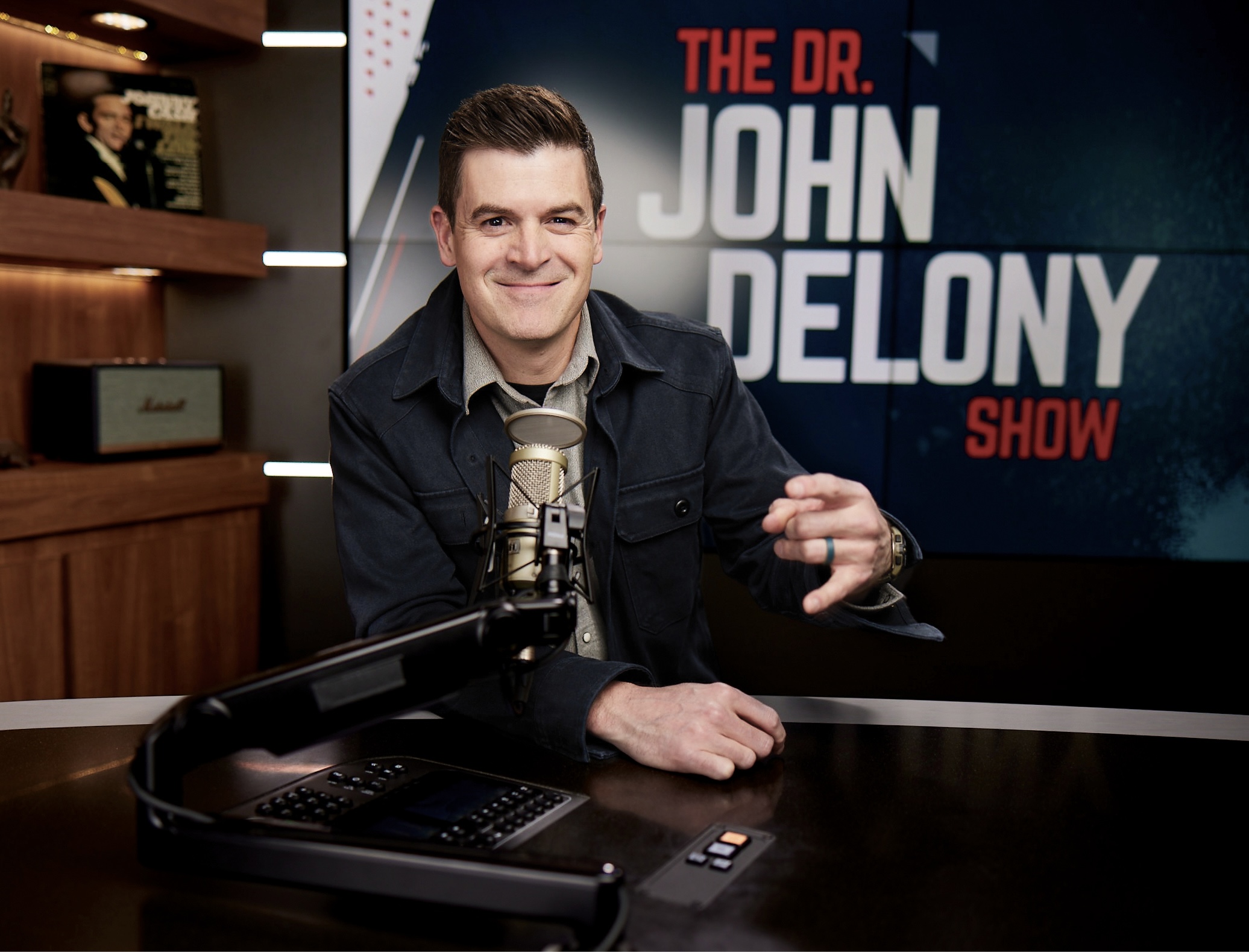
John Delony never wanted “to exist on the internet.” As a mental health expert, he’d been connecting with people—mainly college students—face-to-face for over 20 years. “The greatest gift you can give yourself is to exhale and literally close social media and call real people,” Delony says.
But it’s his ability to connect that led to the success of his rapidly growing platform, which includes The Dr. John Delony Show, a caller-driven YouTube show where he shares insight and advice on mental health, wellness and relationships. Delony’s show is part of Ramsey Solutions, conservative personal finance expert Dave Ramsey’s company.
With tattoos peeking from underneath a short-sleeved black T-shirt, Delony doesn’t exactly fit the classic therapist stereotype. He’s self-admittedly loud; he’s self-deprecating; he’s open about his own struggles and failures.
When he takes a call, he physically leans toward the mic, carefully listening to the caller, pouring over every word, every detail.
Delony’s power manifests in the way he makes others feel: like they’re talking to one of their oldest, most understanding friends. With that approach, it’s not uncommon to hear trembling voices and pauses heavy with stifled tears on his show, which puts out three episodes a week.
While Delony modestly refers to himself as “just a YouTuber,” the truth lies in his show’s success. He’s garnered more than 1.4 million YouTube subscribers with more than 905 million-plus views and 1.7 million Instagram followers since the show started in 2020.
Finding the ‘Next Scariest Thing’
Delony grew up in Houston, Texas, going to rock shows. “I wanted to be a punk rock singer,” he says (guitar riffs in his show’s opening music nod to this redirected dream).
But, as the son of a homicide detective, Delony learned some pivotal lessons at a young age. “When people are running out, you go in,” he says. “The meta message growing up was, ‘Go do the scariest thing if that’s going to help people.'”
Delony’s life and career have been predicated on finding and pursuing the next scariest thing. That’s what led him to work in crisis response and with college students for more than two decades at institutions like Abilene Christian University and Texas Tech University, where he earned two doctoral degrees.
Before joining Ramsey Solutions, Delony served as associate provost and dean of students at Belmont University in Nashville, Tennessee. In fact, it was during a routine talk—just two days into his new position at Belmont—that Delony was “discovered” by a Ramsey Solutions executive, whose daughter was a student.
The executive was so moved by his words that she invited him to speak at the company, headquartered in neighboring Franklin, Tennessee. “I didn’t know it was a job interview, but turns out, it was,” Delony says. That spurred 18 months of conversations, where Delony wrestled with leaving a familiar environment and embracing a very public change. “I liked my anonymity. I didn’t have any social media,” Delony reflects.
Delony consulted with his wife, Sheila (“she’s very wise; she was ‘Dr. Delony’ way before me,” he says of Sheila, a writer and life coach with a doctoral degree in curriculum and instruction). Delony decided that “this seemed like the scariest next right thing to do” to help others, especially in the wake of campus unrest prior to COVID-19.
At the time, Delony was thinking of his two small children. “I told my wife, ‘I at least want to be able to tell them that I got in the ring and tried to make the world a better place,'” he says.
A Call to Action
People come to Delony with a range of problems, running the gamut from the typical (adulterous spouses and moody teenagers) to the extraordinary (texting on ChatGPT for connection and weighing whether or not to donate a kidney to an estranged parent).
Yet there’s always a common thread: a desire to be heard and seen.
While it seems like Delony always has the right—or, at least, a comforting—answer, he readily admits that he doesn’t. Delony insists that sitting with hurting people is the crux of the show. “Whether...the show is a hurting person,” Delony says. “And so, it’s their lived experience that somebody listening to the show gets to hear and experience with them.”
Perhaps one of Delony’s greatest talents is his ability to crack open the men who call into his show, offering a truly safe space for vulnerability. Often, you’ll hear him say:
“Can I tell you somethin’ that I’m hearing?”
“Behavior is a language.”
And, perhaps most importantly, “I’m proud of you.”
Sharing the Burden
Delony acknowledges the fear and uncertainty that accompany vulnerability. It’s a familiar feeling he experienced in his own battle with anxiety. “I know what it’s like to have your brain be anxious [that] you can’t breathe,” Delony says.
For years, he’d lived with racing thoughts and sleepless nights. One night, it reached a crescendo. The U.S. was recovering from the 2008 financial crisis, and Delony was navigating life with an infant son and a new home, while leading a university’s entire housing department.
“I was a human hurricane, held together by a dress shirt and tie,” Delony wrote in his 2022 national bestseller, Own Your Past, Change Your Future.
His new home’s foundation was deteriorating, but he was the only one who could see it. “Spidering cracks” above doors and in the Sheetrock were a telltale sign that even the trusted professionals he’d consulted were missing.
He just knew it.
One rainy night, with a “cheap plastic flashlight” in his mouth, he crawled through mulch, weeds and mud in his underwear at 3 a.m., searching for cracks in the slab that simply didn’t exist.
His home was fine, but Delony had unearthed a bigger problem. “I knew I wasn’t well,” he writes. “I wasn’t having a psychotic break—far from it—but I couldn’t keep going like this.”
Finding the Path Forward
Eventually, Delony drove three hours to meet with a physician friend, saying, “Hey, I don’t know what’s happening in my brain, but I’m not OK.”
His friend’s compassion—and light, loving teasing—was a turning point for Delony, who was able to take actionable next steps toward learning to manage his anxiety. “I was healed literally through—and it was out of desperation—sitting down with another grown man and saying, ‘I’m not all right,'” he says.
With his platform, one of Delony’s core missions has been showing men that they don’t have to have all the answers. “Here’s what it looks like for a big, loud, tattooed-up guy to say, ‘I don’t know, and I’ll sit here with you.' I have been given those moments of grace by other grown men.”
Delony hopes to leave a legacy of love, hope and understanding. “I want everyone to know that, wherever you happen to have found yourself in your life, I want to give you a picture of what it looks like to let someone pull up a seat and say, ‘I’m not OK,'” he says. “Honesty and kindness [are] often the path forward.”
Four Wellness Tips for Leaders
Running a business is more than meeting quarterly goals and defining KPIs. It’s also carrying the mental weight of every decision, every person and every risk. Delony shares how leaders can shoulder the burden while fueling the best version of themselves.
Know your worth.
Culturally, we equate our self-worth with achievement. “That’s insanity,” Delony says, and it’s the first boundary to draw with yourself. The answer is wrapped in who you love and who loves you. “If you define yourself by what you have minus what you owe, then work will always be a place where you are trying to solve for your own worth.”
Foster connection.
“Stop trying to figure out or scroll your way to an answer,” Delony says. Connect with people you admire. Take them out to coffee; sit across from them in real time, engaged in conversation.
Take care of your people.
Everything in our culture is about leverage, so be honest about risk. “When you hire somebody, you bear some responsibility,” Delony says. “They lean on you for work, for opportunity.”
Be a good steward.
Seek out daily practices that honor your body, work and relationships, whether that’s an exercise routine or seeking daily human connection. No matter what you do, do it with dignity and excellence.
Featured image courtesy of Ramsey Solutions
This article was first published in the January/February 2026 issue of SUCCESS® magazine. Get your copy here.