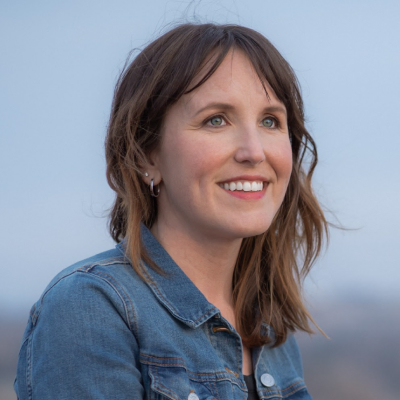
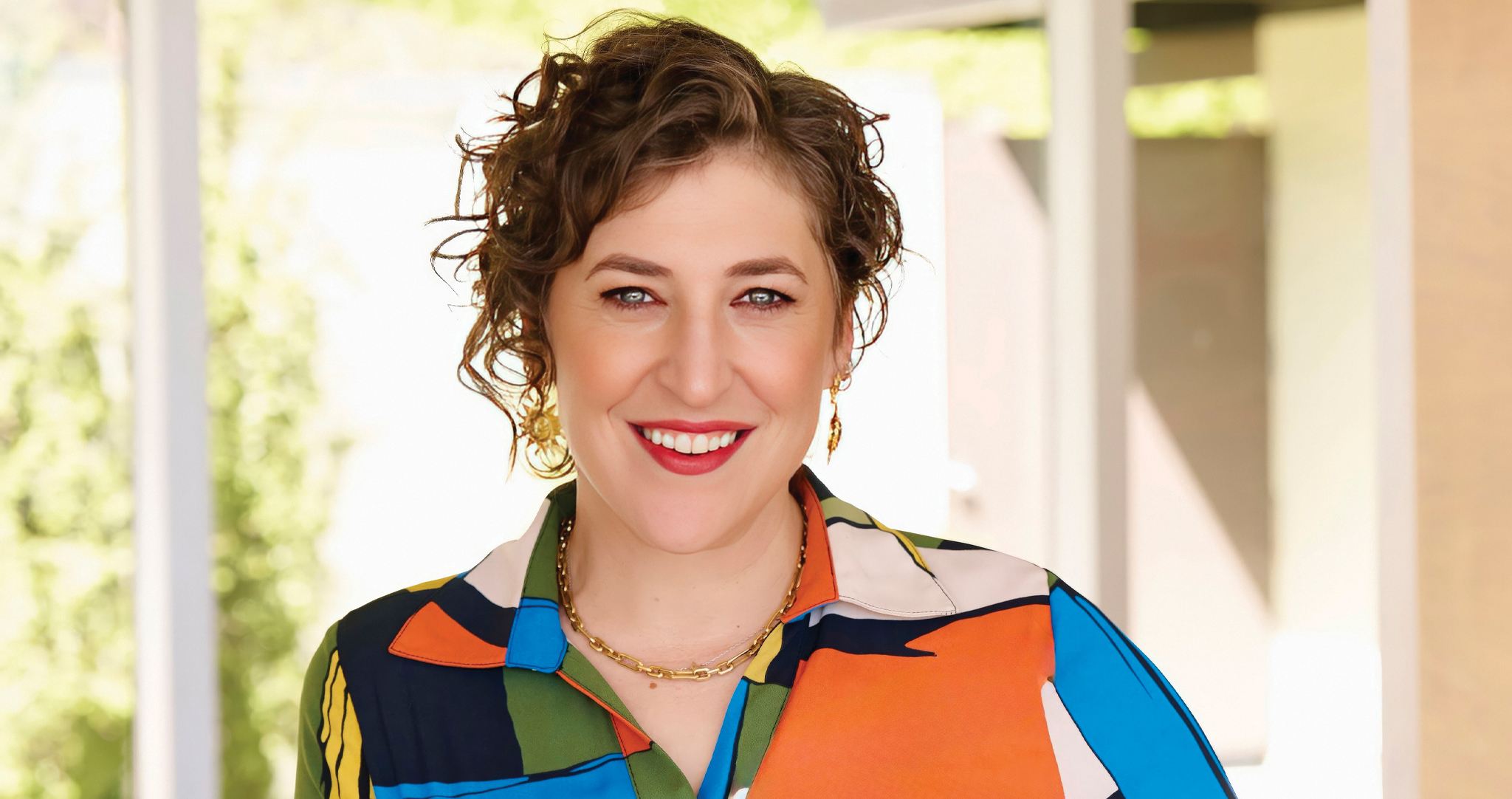
You may know Mayim Bialik as as the quirky teen in Blossom or the brilliant scientist, Amy Farrah Fowler, on The Big Bang Theory, but there’s far more to her than sitcom fame. Bialik didn’t just play the role of a scientist—she is one, holding a Ph.D. in neuroscience from UCLA. She’s also an Emmy-nominated actress, a New York Times bestselling author, former Jeopardy! host and the voice behind the hit podcast Mayim Bialik’s Breakdown. Beyond Hollywood, she’s a musician, filmmaker and STEM advocate who designed (and taught) a biology and chemistry curriculum for homeschoolers. She’s also a mother, a vegan and a social activist. Most recently, she returned to the screen in Father Mother Sister Brother, released this past winter, starring as Adam Driver’s sister and Tom Waits’ daughter.
Calling her “intelligent” feels like an understatement. A modern Renaissance woman, Bialik redefines success on her own terms—through storytelling, science and an insatiable curiosity that inspires others to pursue their own paths.
“I try not to judge success by accolades or kinds of accomplishments,” Bialik says. “I guess I try and think of success as a state of feeling comfort and pleasure with whatever I’m doing. So whether that’s being at home making lunch for my kids or it’s walking a red carpet to try and win an Emmy or it’s getting a Ph.D., for me, success is really about what it feels like when you close your eyes and get quiet, no matter what you’re doing.”
Believing that success is ever-evolving, shaped by our origins and where we dare to seek, for Bialik, that perspective is deeply personal. Her grandparents immigrated from Eastern Europe to America, and for her mother’s generation, success meant achieving what their parents couldn’t, such as finishing their education.
“I was raised with this notion that success is going to college, getting married, being someone’s wife.... For me, it definitely has evolved,” she says.
For Bialik, science and acting aren’t opposing forces—they’re two sides of the same creative coin. Her journey from child star to neuroscientist is fueled by a boundless desire to understand people and the world around her. “I like to psychoanalyze everyone that I meet..., but now I have more information with which to do it,” Bialik says. “Being trained as a scientist means that I get to see the world as a scientist, no matter what I’m looking at.” She approaches the world through an analytical lens—one that enriches both her storytelling and her pursuit of knowledge.
“I do think that my love for my interest in science, and then my growing interest in mental wellness and sort of the evolution of the conversations that we have about what it is to be human, definitely has influenced my decision to start a podcast [and to] continue the podcast as a main force in my life,” she explains.
REWRITING THE SCRIPT ON SUCCESS
As a trained science educator with a passion for mental health, Bialik saw an opportunity to share her insights with a broader audience. Years of wisdom from therapists, practitioners and alternative experts had shaped her own journey, and now she was ready to pay it forward.
Initially planned as a talk show, the idea shifted during the pandemic when co-host Jonathan Cohen suggested a podcast. Though new to the medium, Bialik embraced the challenge. She converted her house into a studio, and Mayim Bialik’s Breakdown was born—offering raw, insightful conversations that demystify mental health and self-discovery.
“We wanted to be part of the change of conversation in how we view wellness,” she says. In the five years since they launched, conversations around mental health and wellness have undergone a remarkable transformation. What was once a stigmatized topic is now part of mainstream dialogue, opening doors for deeper understanding and acceptance.
Bialik notes that the show has shifted beyond simply breaking down stigma, since many myths around mental health have already been dispelled. “We’ve broken down a lot of those barriers, and so what is left is to continue to explore what works for people, both celebrities and experts. What are the unifying concepts we can understand about mental health and mental wellness, and what does it mean to be human and live to the height of our capacity—mentally, physically and spiritually?”
Grateful for the opportunity to carve out her space in the science and mental health realm—a field where women remain underrepresented—Bialik takes pride in standing out among the many respected voices in podcasting. Especially notable is her distinction as one of the few nonmedical doctors consistently ranking among the top health podcasts, with “tens of millions of downloads,” according to Bialik. It’s the winning combination of brains and relatability that makes listeners keep tuning in.
“In many cases, those spaces are reserved by people like Andrew Huberman and Peter Attia,” she says. “They’re kind of like the bro [culture], wellness, amazing doctors. But for a lot of women, we don’t necessarily hear that information the way that it’s tailored for us from a lot of the male mental health podcasts or wellness podcasts.” Bialik sees her podcast as meeting a specific need by delivering health insights tailored for women.
The podcast, part of the Impact Theory network, has since evolved into a powerful platform that explores the human experience through a scientific lens, delving into the intersection of mental, physical and spiritual well-being. Offering listeners direct access to expert insights—as if they’ve attended appointments with leading professionals—the show provides practical, actionable advice, all available for free.
BRIDGING THE GAP IN MENTAL HEALTH ACCESS
One of the driving forces behind launching the show was a deep sense of frustration over the inequality in access to mental health care—particularly the belief that it should only be available to those who can afford it. “We, in many cases, are giving people the opportunity to sit down with experts that they otherwise wouldn’t get to talk to or learn from,” she expresses.
She relishes using her science background, coupled with the fact that she’s a “curious mind,” to ask questions on others’ behalf. Although the podcast has also played a pivotal role in her own growth, she finds it cathartic and validating to hear guests open up about struggles like imposter syndrome or share hard-won wisdom from having overcome trauma. It’s the fusion of science and spirituality that truly transformed her approach to health and daily life. As she humorously puts it, she’s the “robot” who absorbs knowledge and shares it with Cohen and their producer.
One guest’s life-changing experience with transcendental meditation inspired Bialik to incorporate it into her routine, committing to 20 minutes of practice twice a day. Learning from her guests has become an enriching part of her own evolution.
“I’m not necessarily a slow learner, but I’m a fast forgetter,” she says. “So, for me, getting to speak to all these experts—and I think that’s probably a lot of people’s experience—it’s good reminders of loving-kindness meditation. It’s reminders of understanding that we’re one with the universe. It’s reminders that we’re going to be OK even when we’re in pain—that we’ve survived 100% of everything we’ve been through if we’re still here today.”
CARVING OUT SPACE IN A MALE-DOMINATED FIELD
Whether it’s through earning a doctoral degree in neuroscience from UCLA or podcasting, taking on the role of rewriting the rules never seems to intimidate Bialik.
“It’s a secret club that you’re part of as a female scientist,” she says. “Entering a podcast space and a wellness space—where so many clicks and views are dominated by men—it definitely feels different because I know that for me, as a woman, I don’t always listen the same to men as I do to women.”
She stresses that women deserve equal access to health and biohacking knowledge, presented in ways that resonate with them.
However, she finds this poses a challenge, recognizing that women who come from diverse backgrounds and experiences all deserve a space where they feel valued and included.
“So, when people would ask me, ‘How do we get young girls involved with STEM?’ There’s not one way,” she says. “For some young women, learning the chemistry of lip gloss is going to be what engages them. And it might make them go into chemistry or pharmacology. And for other women, they might say, ‘I really want to be alone in a laboratory looking under a microscope.’ There’s not one kind of female experience.... We get to resist the urge to conform, to make people comfortable with what a woman is like—and the fact is women are like all sorts of things.”
FINDING BALANCE IN THE SPOTLIGHT
Bialik, having grown up in the public eye, understands the challenge of balancing work and personal life but believes it’s possible. She admits that whether she’s achieved that balance depends on perspective—her kids, for instance, might say they missed her or wished she spent less time on her phone, something she continues to work on.
She values perspectives like social psychologist Jonathan Haidt’s, which highlight the pressures facing today’s “anxious generation”—not just among kids but adults as well. Reflecting on her own experience, she remembers feeling an ongoing urge to work, even when it wasn’t necessary. She recalls the early days of smartphones and conversations with her manager about always being reachable, even during moments like taking her kids to the park.
Now, with more experience and perspective, she’s reclaiming her time and shaping what balance means. Bialik reflects on a question many, especially women at a certain stage in life, find themselves asking: Am I living the life I truly want, or the one others expect of me? She acknowledges how easy it is to get caught up in maintaining a certain lifestyle—whether it’s the size of a home, beauty standards or financial expectations. But she believes the real question is deeper: How do I want to wake up each day? What pace of life feels right for me? In a culture that glorifies overachievement, she challenges the idea that success should come at the cost of personal fulfillment. “It’s seen as a symbol of success to be productive, but we really are human ‘beings’ and not human ‘doings,’ and I think for most of us, we spend our life being a human ‘doing.’”
MASTERING THE MIND: STRATEGIES FOR GROWTH
The multihyphenate believes that life is a continuous recalibration of reassessing and redefining what we want it to look like. Surrounding herself with supportive people helps her navigate mental challenges, like imposter syndrome. For her, the relationship between imposter syndrome and productivity is a bit of a “chicken-and-egg” dilemma—does she take action to silence those feelings, or do they persist no matter how much she accomplishes?
“I think women do need a support system, and it’s important to have girlfriends,” she highlights. “It’s important to have people [who] you can vent to. But in terms of actually making sort of productive changes, I really do rely on the support of women who have more experience than I do. Specifically, ones who have tackled that work-life balance.”
Another growth strategy Bialik emphasizes is the profound impact believing in something greater than oneself has on mental and physical health. It’s a perspective she has explored on her podcast through conversations with both atheists and believers. She says it not only strengthens your immune system but that it elevates all of the chemicals in your body that keep you feeling resilient.
“While organized religion is not for everyone, there are many, many ways to be connected to something bigger than you. Meditation is one way to get there, mindfulness, loving-kindness—all of those things are things that I continue to incorporate into my life.
“That’s not just a mystical concept,” she says. “It’s one that’s rooted in what we know about physics and what we know about the way the world is constructed.”
One of the most surprising aspects of the podcast has been how it deepened her perspective as a person of faith. Through conversations with countless scientists, she’s found that many share a profound belief in something greater—an idea fueled by hope, love, peace and human connection. In a world that often feels divided, holding onto that belief isn’t always easy, but it has become a powerful, unifying thread in the conversations and mission of the podcast.
“We can kind of create a better reality, and I’m comforted as a scientist to know that that’s not just hocus-pocus. It actually has a basis in the scientific world and the real world,” she says.
At its core, her journey—both personal and professional—revolves around the pursuit of understanding, healing and connection. Whether through science, spirituality or community, she continues to explore the many ways people can grow, support one another and find deeper meaning in their lives.
Featured image by John Russo.
Cover story originally published in theMarch/April 2026 issue of SUCCESS magazine. Get your copy here.