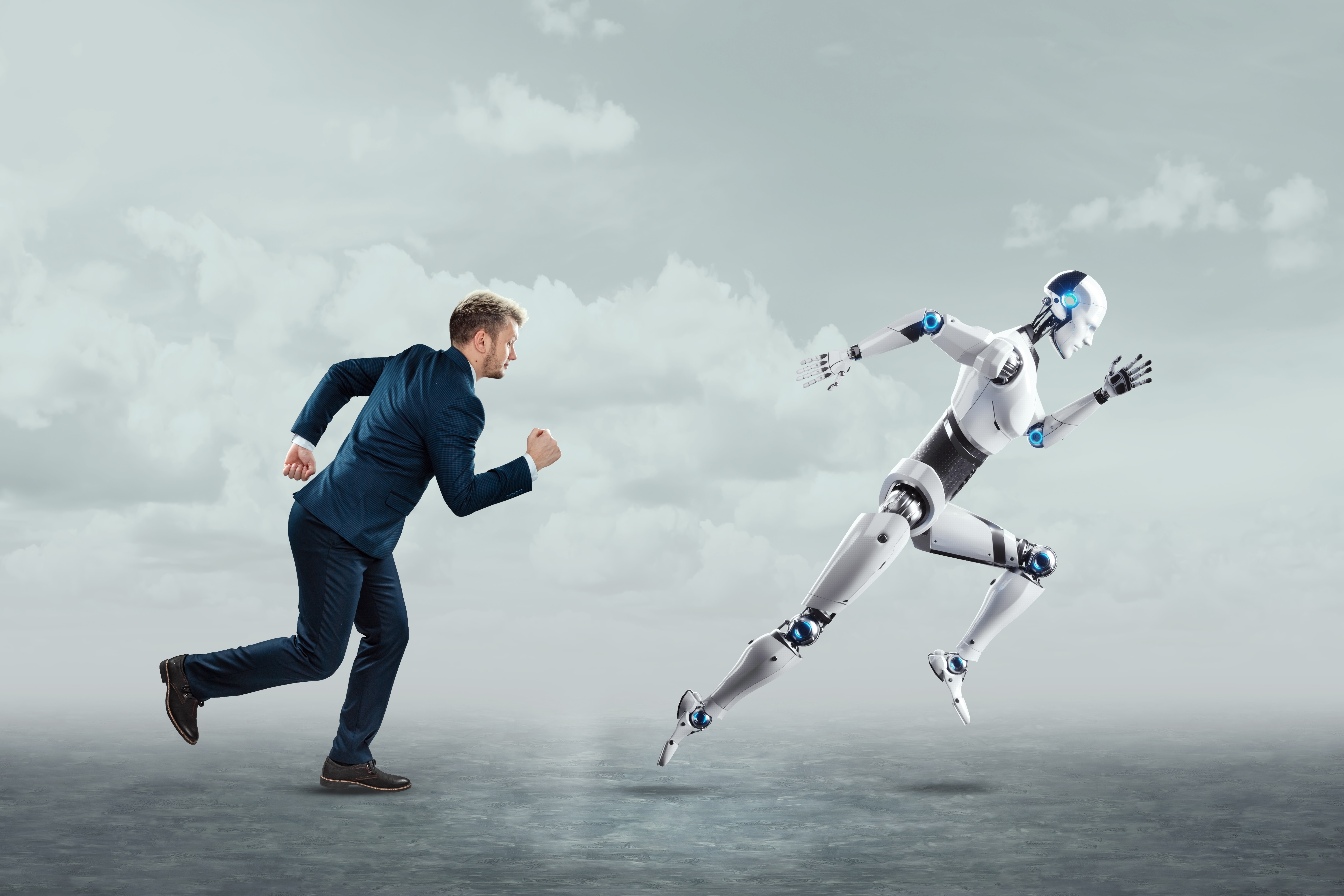
This past weekend, a robot didn’t just beat human runners. It obliterated the world record.
On April 19 in Beijing, a humanoid robot from Honor, a Chinese consumer electronics company, completed a 21-kilometer half-marathon in 50 minutes and 26 seconds—faster than the human world record set by Uganda’s Jacob Kiplimo just weeks earlier. The robot navigated the course autonomously, without remote control, on public roads alongside 12,000 human competitors.
If that were the whole story, it would be impressive but easy to dismiss as a novelty. The real story is what happened in the 12 months before that finish line.
Why 1 Year Changes Everything
At last year’s inaugural event, the winning robot finished in 2 hours and 40 minutes. Only six of the 21 competing machines made it across the finish line at all. This year, four robots posted times under one hour, dozens finished and the winner broke a record that the world’s best human athletes spent decades chasing.
That’s a 68% performance improvement in a single year on a task designed to push machines to their physical limits in real-world, uncontrolled conditions.
This isn’t a story about robots outrunning people on a Beijing road course. It’s a story about the compounding speed of machine intelligence and what that pace means for every professional planning to work in the next decade.
The Workplace Shift That’s Already Underway
Even more important: Humanoid robots aren’t just racing. They’re already showing up at work.
BMW, Amazon and Mercedes-Benz are all running active pilots: handling parts, moving logistics inventory, transporting heavy materials on assembly lines. According to a McKinsey analysis of early commercial deployments, the first wave is concentrated on repetitive, moderately complex tasks in structured, low-variability environments like factory aisles, warehouse lanes and routine inspection routes.
None of this is mainstream yet. According to a blog post on Robozaps, mainstream adoption is projected between 2028 and 2032, with broad scale-up expected through the mid-2030s. You’re not walking into the office next Monday to find a humanoid at the neighboring desk.
But the window is closing faster than most professionals have accounted for in their career planning.
The Numbers Behind the Speed
Between 2023 and 2024 alone, humanoid robot manufacturing costs dropped by 40%, which is faster than analysts had projected. China invested 73.5 billion yuan (roughly $10.8 billion) in robotics and embodied AI in 2025 alone, and Beijing’s current five-year plan explicitly designates humanoid robotics as a national priority. At CES 2026 in January, Nvidia CEO Jensen Huang declared that the humanoid industry is accelerating on the back of AI infrastructure being built for entirely other purposes.
The Beijing race demonstrated something a lab test cannot: real-world durability. Uneven pavement, crowds, weather, unpredictable obstacles, the winning robot navigated all of it autonomously. That’s the calibration that matters for workplace readiness, not the trophy.
What ‘Normal Colleague’ Actually Looks Like
The IEEE recently surveyed technology leaders across six countries and found that 77% believe humanoids will eventually feel like commonplace co-workers. Not a threat. Not a curiosity. Just another presence on a team.
IEEE senior member Bhushan Patel estimates five to seven years before humanoids start to feel like a normal part of everyday work environments. That’s closer than the last time most organizations updated their technology strategy. It’s also a more useful planning horizon than either the breathless hype or the reflexive dismissal that tends to dominate coverage of this moment.
In research on the future hybrid workplace, JLL framed the shift this way: The next era of hybrid work won’t be defined by where you work, but by who—or what—you work with. That reframe is worth holding onto.
The Advantage You Can Build Right Now
Here’s what the fear-driven narrative consistently misses: The rise of capable machines doesn’t flatten human value. It concentrates it.
The roles most vulnerable to humanoid automation are structurally defined by physical repetition such as sorting, assembling and transporting in predictable environments. That’s where the numbers make sense first. The skills that appreciate in this environment are the ones machines are architecturally bad at: judgment under ambiguity, trust-building, ethical decision-making and the ability to translate between AI output and real human context.
One recent analysis captured the stakes clearly: The half-life of a technical skill in 2026 is roughly 18 months. The professionals who will be indispensable in 2030 aren’t the ones who know the most at any given moment. They’re the ones who can unlearn fastest and redirect their expertise toward problems machines still can’t navigate.
That’s not a threat. That’s the clearest career signal you’ve seen in years.
3 Moves to Make Before 2028
You don’t need to become a robotics engineer. You need to be deliberate about where you’re building value that compounds and where you’re unconsciously building value that won’t.
Audit your task stack. List every recurring task you do in a week. Then sort them honestly: Is this physical and predictable? Is it judgment-based and contextual? Is it relationship-dependent? The first category is precisely what humanoid robots are being built and funded to do. Your leverage lives in the other two, and that’s where your energy belongs.
Start working alongside AI now. The professionals who will direct, evaluate and manage humanoid robot workflows in 2030 are the ones building fluency with AI tools in 2026. This isn’t about staying current with software. It’s about developing the intuition for human-machine collaboration that is about to become the baseline expectation for senior roles across every industry.
Invest in irreplaceable skills. Strategy, empathy, creative problem-solving and the ability to build trust in high-stakes situations—these aren’t soft skills anymore. They’re the premium layer of a workforce that is about to become increasingly automated at its foundation. The professionals who master what machines can’t replicate are the ones who will define what leadership looks like in the next decade.
The robot that crossed the finish line in Beijing didn’t win because humans fell behind. It won because its team iterated relentlessly for 12 months and compounded every improvement. That’s not a threat. It’s a model.
The question isn’t whether this technology is coming. It’s whether you’re building the kind of career that gets more valuable as it does.
Featured image from Marko Aliaksandr/Shutterstock