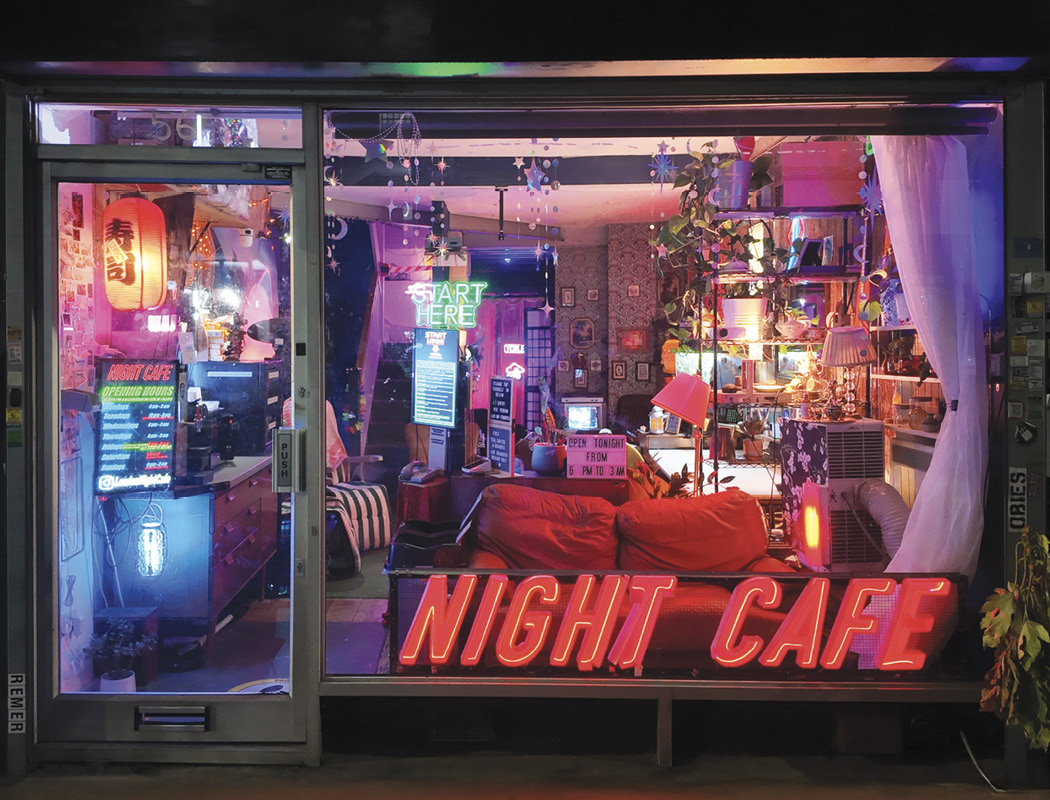
Late at night, long after London’s Aldgate neighborhood has emptied of office workers in suits, a cozy glow emanates from 56 Middlesex St. If you weren’t here on purpose, you might scratch your head as you wander on by. Why would someone put their living room sofa directly in front of a floor-to-ceiling window at ground level, facing the street?
That’s what happened when passersby walked past the London Night Cafe, which stays open as late as 5 a.m. They kept going, unaware of the eclectic introvert paradise within.
Then, in 2024, the media brand Secret London caught wind that there was a living-room-style space with unlimited tea, coffee and biscuits; a fake beach with a heat lamp; a massive plush seating nook called the “cuddle puddle”; and a ball pit—all for an entry fee of £7, or about $10.
How Did London Night Cafe Get Started?
Overnight, Eric Wycoff Rogers’ “third space” endeavor, which spans the basement and first floor of a mixed-use townhouse where they live, became a smash hit.
The idea was born out of something Rogers wished they’d had as they worked on their Ph.D. in history at Cambridge University, when they became “completely nocturnal.” Rogers wanted a place where they could read or write alone but in the company of other people, and they started looking for such spaces after moving to London.
“I started to realize there was a real dearth of nightlife spaces that felt accommodating in that way,” Rogers says. “I was like, ‘Surely, it’s more than just me that wants to go somewhere quiet late at night.'”
So, they created it. But for a long time, no one came.
Aside from an Instagram account, Rogers did no marketing, instead focusing on freelance and consulting work during opening hours. Many nights, not a single guest showed up. Sometimes, Rogers would invite friends over so they wouldn’t have to be alone in the space, and potential customers wouldn’t be dissuaded by the lack of traffic.
“I remember thinking, ‘This would be so great if it had people in it,'” Rogers says. “You might encounter the coolest thing in the world, but if it’s empty, you’re gonna be put off by that.”
Once that Secret London video went viral, everything changed. It’s been a little over a year since then, and the café is now buzzing almost every single night.
Make Noise—When You’re Ready
Rogers averted potential disaster in the café's early days by implementing a no-alcohol rule. It was originally BYOB. That quickly got out of hand when a rowdy group came in one night and damaged both the space and its peaceful atmosphere, Rogers says. The no-alcohol rule was implemented shortly after (though guests are allowed to bring in their own food).
How Does London Night Cafe’s Honor System Work?
Rogers has been managing the cafe almost exclusively since it opened, which means they’re basically trapped on-site during all open hours. To ease some of that burden, Rogers rigged an old telephone to share recorded explanations about the space and installed a tap-to-pay card reader at the entrance for people to check themselves in.
People warned Rogers that, within days, the place would be trashed. But Rogers was inspired by farms in the English countryside where fresh eggs are sold at the end of driveways on the honor system. So, they gave it a shot and found that people took that trust seriously.
“I think people give back what they receive,” Rogers says. “Treating people generously, and as trustworthy, has worked, even in central London, which is supposedly a place where no one behaves.”
Can You Replicate a Quiet ‘Third Place’ Business Model?
Occasionally, Eric Wycoff Rogers hears from people who want to create something similar in their own community.
“Presumably, the place you’re in has different needs than here,” Rogers says. “But I do try to explain to them whatever has worked for us and see what’s applicable to their situation.”
Here are a few of their tips for creating a valuable space for the needs of your own city.
1. Say ‘No’ to Grow the Right Way
Every decision you make in the early days can impact the vibe and culture you project. Rogers has hosted many events at the space, such as queer speed-dating events and academic-style discussions, and has stuck to events that mesh with the chill atmosphere they’re trying to create.
“This is just a cozy place to read a book and have a conversation,” he says. “We don’t have to be everything to everyone.”
2. Anticipate Your Customers’ Needs
“Some nights, I overheard people saying, ‘Oh, this person was trying to talk to me, and I was really just trying to read,'” he says. “I felt like we needed some way to actually give a cue for that.”
So, Rogers hung plastic necklaces under a sign reading “introvert beads.” They’re the same strings of beads you’d see at Mardi Gras, and they’re meant to act as a clear signal for anyone who’s not feeling social.
3. Give People Stories to Tell
One of the things that makes the London Night Cafe infinitely memorable is that it’s full of distinct spaces and clever quips (i.e., labeling a trash can as a receptacle for Top 40 pop music).
“People like to have a funny little story to tell about something, or to feel like they’re looking at something and it’s setting itself apart from other things,” he says. “For us, that’s the ball pit, or the rave bathroom or the fake beach. They just feel like these are things they can tell a story about.... It makes people feel like they’re in on some kind of joke together.”
How Do You Scale a Business Without Losing Its Culture?
These days, Rogers occasionally hires help to manage the space so they can take a night off. But even though the space exploded in popularity after its 15 minutes of fame, they’ve been able to keep the laid-back atmosphere. Rogers has a strict cap of about 30 people in the space at one time, and they implemented a reservation system (and a higher entrance fee) for Friday nights.
But that first year, more silent than quiet, wasn’t wasted time—it was the foundation that made this place exactly what its guests love it for.
“One of the key ways to repair our social fabric and the low trust that people have in each other is to just be in space together,” Rogers says. “There’s something powerful about doing things in parallel with other people and feeling like you’re part of the bigger group of humanity.”
Featured image courtesy of London Night Cafe
This article was first published in the May/June 2026 issue of SUCCESS® magazine. Get your copy here.