On nights outside Oslo, when the trails fall quiet and the forest stretches into black nothingness, Jørgen Jørgensen, a 53-year-old executive, heads outside.
He’s not alone.
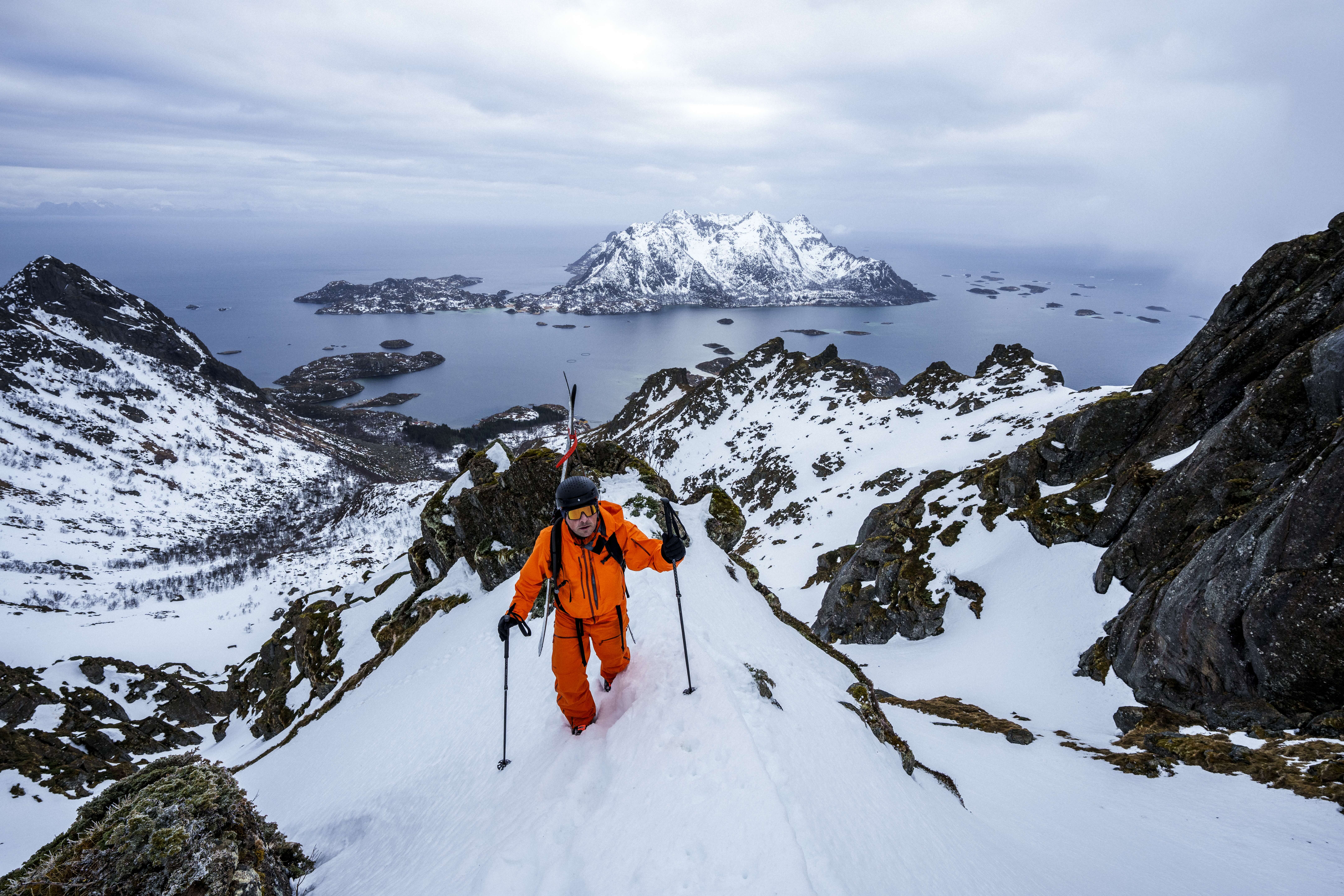
His two Irish setters, Bruno and Luring, are by his side, and he’s taken plenty of other precautions. There’s a headlamp jutting from his honey brown hair, and he’s wearing the skis that, at this point, are extensions of his legs (Jørgensen has been cross-country skiing since he was three years old).
However, there are no crowds and next to no lights. There’s just the narrow beam ahead, the rhythm of movement and the sound of dogs cutting through snow.
And Jørgensen wouldn’t have it any other way.
These nighttime walks are the epitome of friluftsliv, a Norwegian philosophy that translates to “open-air life” and is all about connecting with nature to improve your physical and mental well-being.
“If you want to do stuff, you just have to go out no matter what kind of weather,” Jørgensen says. This is especially true in Norway, where, nearly 100 years ago, Jørgensen’s family founded an apparel company that’s now on the cutting edge of the luxury travel market.
The Roots of a Storied Brand
Founded in 1929, Norrøna got its start by making essential products for an unforgiving landscape, including leather straps, canvas backpacks and durable outerwear.
By the 1970s, the company had become a quiet innovator, outfitting expeditions and introducing Europe’s first Gore-Tex jacket. Its products were battle-tested by climbers and skiers, and it was around this time that a young Jørgen was cutting his teeth on skis, rocks and any other terrain his family let him traverse.
He is now the fourth-generation owner of Norrøna, and by his own estimation, he spends 140 to 150 days of the year “out in nature,” whether he’s skiing, biking, running or windsurfing (yes, he traverses water, too).
In other words, friluftsliv has defined his life, just as it’s defined the company he now owns.
As Jørgensen marks 20 years leading the 97-year-old company founded by his great-grandfather, Norrøna is both outfitting explorers and designing the environments they move through. Around 10 years ago, cognizant of the centennial celebration on the horizon, the company launched Norrøna Adventure: an outdoor experience division that now operates more than 100 guided expeditions across 50 countries.
Their portfolio includes an Arctic expedition yacht built for ski-and-sail journeys and an off-grid mountain biking retreat in the southern Norway region of Telemark, as well as a growing network of remote lodges in northern Norway. While growing this side of the business, Jørgensen has applied the same philosophy he uses in product development: functional design, real-world testing and what the company calls “Loaded Minimalism,” which means every product has all of the technical essentials (in addition to looking sleek).
As Jørgensen and his company prepare to celebrate 100 years in business, they want to completely eliminate their environmental footprint while tapping into friluftsliv—a long-held tradition that may be the key to elevating customers’ experiences in the endlessly competitive travel market.
It’s a lofty goal that likely takes a true outdoor enthusiast to accomplish.
“It’s not enough to only provide the best products,” Jørgensen says. “We also have to offer unique adventures.”
Big Goals, Bigger Experiences
In 2016, during a long-range strategy session, Norrøna’s leadership got honest with themselves. They knew the big 100th birthday was coming up fast, and they wanted to know what it would take to become the most premium outdoor brand in the world (No one can accuse Jørgensen of dreaming small).
The answer to their question wasn’t just better gear. They resolved to take people on luxury journeys as far as the South Pole or Greenland, and they want to build community along the way.
“We need to see and meet our customers and have a personal relationship with them,” Jørgensen says. “All of this is bringing more people out in nature, either by giving them the right tools with products or organizing small events or organizing bigger trips.”
The company operates dozens of retail stores globally, using them as both points of sale and as hubs for bringing customers together. And beyond those brick-and-mortars, Norrøna organizes outdoor gatherings and events centered on skiing, mountain biking and ice climbing. Each event is designed to help participants build skills while connecting with like-minded people from around the world. While digital platforms help drive awareness, the brand ultimately sees itself as physical at its core—built on shared, real-world experiences rather than virtual ones.
One such experience is Norrøna’s Varg sail yacht, which TIME magazine recently included in its list of the World’s Greatest Places. The 62-foot craft was designed for trips through the Arctic Circle, and it’s intimate by design, carrying just six guests in three cabins and boasting a scrumptious seafood menu, a sauna and ample whale-watching opportunities.
“It’s a full brand experience that you can smell, taste, feel, touch the brand,” Jørgensen says. “And this way, we are also in a good dialogue with our consumers to hear their impression: in what direction do we want to go further on?”
A Community & Its Caretaker
By bringing customers into remote environments—where they use the gear, meet guides and engage with the brand firsthand—the company creates a fully immersive ecosystem. These experiences deepen loyalty and create a valuable feedback loop for Jørgensen and his fellow leaders, informing future product development through direct interaction with a global community.
For instance, Norrøna hosts festivals devoted to running, ice climbing and freeride skiing (the art of skiing on natural terrain). Each year, the company’s fans gather in a luxurious locale and enjoy a massive adventure, but for Jørgensen (and some of his company’s faithful), the friendships they forge are just as rewarding as the thrills on the mountain.
Jørgensen relays a story of a guest who joined a sailing expedition with little prior knowledge of the brand and became, almost immediately, a devoted follower. After the trip, he sent handwritten letters to the crew and main guide, describing the experience as something he had never encountered before.
For Jørgensen, that reaction is the point.
“Being able to create something that really enriches your life—that’s part of our motivation,” he says.
Jørgensen describes himself less as an owner than a caretaker, responsible for maintaining a relationship that spans generations of customers. That relationship is built on longevity: The company has made it this far because they’ve prioritized resiliency, both in their products and as an approach to business.
“I think great design, it could be innovative,” he says, “but you don’t get tired of it after 13 years.”
At the same time, Jørgensen knows being resilient means that what got you to 100 years won’t get you to 200 years. He knows his company will continue to evolve; it has to. Because just as jackets stopped being enough, customers will tell them—sooner or later—that they want even more of this, or maybe a little less of that.
Jørgensen will be around for some of that, but not all of it.
“I have kids, too,” he says. “They will probably come in and hopefully take over one day, and they will do some slight changes like I did with my father. But we are building a brand with the perception of eternal ownership.”
When he does indeed hang it up, it’s unlikely he’ll hang up the skis. It’s easy to picture Jørgensen, a couple of decades from now, still hiking through the Norwegian wilderness.
“I think if I didn’t have that,” he says, “there would be a big hole in my life.”
Image courtesy of Jørgen Jørgensen
This article was first published in the September/October 2026 issue of SUCCESS® magazine. Get your copy here.