
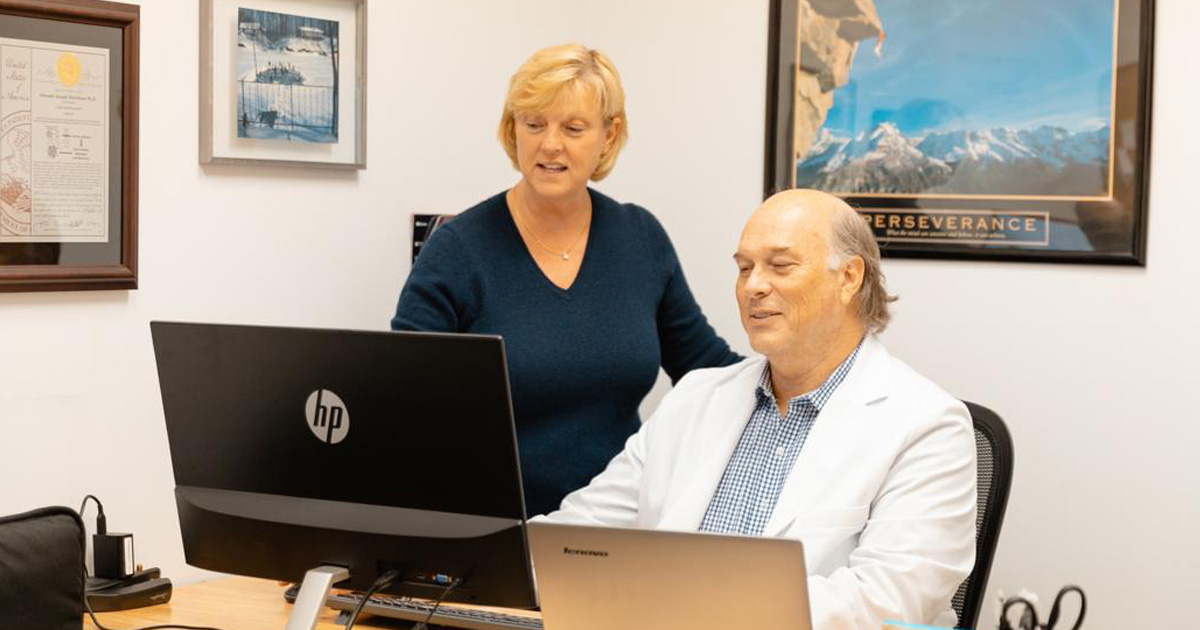
In oncology, targeted therapy is growing rapidly, an approach that zeroes in on specific genetic mutations and tailors treatments accordingly. And it’s not without its wins. Over 40% of cancer drugs approved between 1998 and 2022 are now classified as precision therapies, offering patients longer survival and fewer side effects compared to traditional chemotherapy. But for Donald (Don) Davidson, PhD, and Anita Davidson, DPT, co-founders of Creative BioTherapeutics LLC (CBT), that progress is only part of the story.
Offering a new approach with CBT300
A classically trained biochemist, Don Davidson is used to looking at problems systemically. While much of the field now focuses on placing cancer into genetic categories, he argues that mutations don’t act in isolation. He asserts they affect cascades of proteins, alter cellular behavior over time and evolve as the tumor adapts. “We’re not saying targeted medicine is bad,” Don Davidson clarifies. “We’re saying that it’s not enough. If we throw all our eggs into that basket, we risk ignoring the bigger picture. We need to realize that it’s not a snapshot but a movie.”
That “movie” is what the Davidsons believe the industry needs to watch more carefully. Through CBT, they’ve developed CBT300, a first-in-class biologic therapy designed to dismantle the survival mechanisms of cancer cells at a fundamental level. The therapy targets GRP78, a stress protein found on the surface of many diseased cells, including those involved in cancer, neurodegenerative diseases and even some viral infections.
GRP78 acts like a shield, protecting harmful cells from immune attack and drug penetration. According to the company, preclinical trials of CBT300 have shown promising results, including complete regression of some drug-resistant tumors, without the toxicity usually associated with chemotherapy.
Learning to explore new paths
However, their real argument isn’t just whether a cancer is drug resistant or not, but how science, in general, moves forward. And often, it moves through failure.
Roughly 90% of new drug candidates never make it past clinical trials. In oncology, the success rate is even lower. Those drugs that are approved through accelerated pathways are often based on early data rather than confirmed survival benefit. Less than half go on to demonstrate meaningful clinical results five years later.
“You’d think failure is bad,” Don Davidson says. “But in research, failure tells you where not to go. That’s incredibly valuable. If we can say, ‘this doesn’t work,’ then the next person won’t waste time repeating it; they’ll explore a new path.”
Anita Davidson, who comes from the provider side of healthcare, sees it from a patient-centered perspective. She says, “We iterate. We learn from every patient. No treatment works perfectly the first time. The real question is, are we listening to the lessons that failure teaches us?”
Striving for balance and new pathways in cancer treatment
The Davidsons are not advocating for abandoning precision medicine. On the contrary, they believe it plays a vital role, particularly in emergencies or highly specific cases. But they’re calling for balance. While there needs to be research for the highly specialized, mutation-specific therapy, they maintain that it’s important to also look at ways to block or inhibit cancer cells before they evolve into something untreatable. “If you hit cancer before it adapts, you might be able to stop it before it specializes,” says Don Davidson.
That philosophy underpins the development of CBT300. Instead of targeting a mutation in a gene that may only exist in a fraction of patients, it targets a mechanism that many cancers use to survive: GRP78. By disrupting this core protective system, they believe they can address a broad spectrum of drug-resistant cancers and possibly other diseases that exploit similar pathways.
There’s a human urgency to their work, too. While science debates funding models and trial endpoints, patients are often still waiting. They may miss out on effective treatments because those treatments haven’t cleared the regulatory pipeline. Anita Davidson further iterates, “This happens especially in aggressive cancers such as glioblastoma. You can see that the outcomes still haven’t improved significantly in decades. We’ve got to do better.”
Looking at medicine through a holistic lens
Part of doing better, they argue, means restoring a holistic lens to medicine. Anita Davidson likens it to treating a patient through a straw, wherein specialists zoom in on tiny details but miss the full picture. “Specialization is valuable. But for complex diseases, you also need someone looking at the person as a whole,” she says.
Ultimately, their message is one of humility and persistence. Their company, CBT, reflects that ethos. It’s not just about creating new drugs. It’s about striving to create smarter, more adaptable science, one that puts patients before profits. Rather than seeing scientific failure as a defeat, CBT is advocating we accept it as a necessary step toward real progress.
This article is for informational purposes only and does not substitute for professional medical advice. If you are seeking medical advice, diagnosis or treatment, please consult a medical professional or healthcare provider. Photo courtesy of Creative BioTherapeutics.